

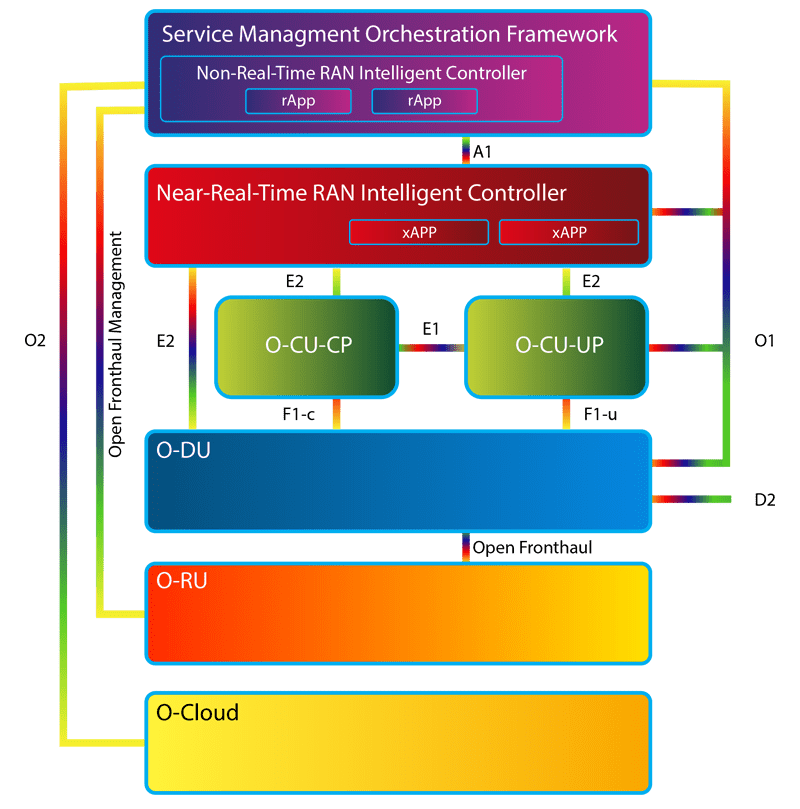
It has overall responsibility for the O-RAN Architecture and Use Cases. WG 1 identifies tasks to be completed within the scope of the Architecture and Use Cases and assigns Task Group leads to drive these tasks to completion while working across other O-RAN Work Groups.
The primary goal of Non-RT RIC is to support Non-Real-Time intelligent radio resource management, higher layer procedure optimization, policy optimization in RAN, and providing AI/ML models to Near-RT RIC.
The focus of this WG is to define an architecture based on Near-Real-Time Radio Intelligent Controller (Near-RT RIC), which enables near-real-time control and optimization of RAN elements and resources via fine-grained data collection and actions over E2 interface.
The objective of this WG is to deliver truly open fronthaul interfaces, in which multi-vendor DU-RRU interoperability can be realized.
The objective of this WG is to provide fully operable multi-vendor profile specifications (which shall be compliant with 3GPP specification) for F1/W1/E1/X2/Xn interfaces and in some cases will propose 3GPP specification enhancements.
The cloudification and orchestration WG seeks to drive the decoupling of RAN software from the underlying hardware platforms and to produce technology and reference designs that would allow commodity hardware platforms to be leveraged for all parts of a RAN deployment including the CU and the DU.
The promotion of open reference design hardware is a potential way to reduce the cost of 5G deployment that will benefit both the operators and vendors. The objective of this Work Group is to specify and release a complete reference design to foster a decoupled software and hardware platform.
The aim of this WG is to develop the software architecture, design, and release plan for the O-RAN Central Unit (O-CU) and O-RAN Distributed Unit (O-DU) based on O-RAN and 3GPP specifications for the NR protocol stack.
This WG focuses on the transport domain, consisting of transport equipment, physical media and control/management protocols associated with the transport network.
This WG is responsible for the OAM requirements, OAM architecture and the O1 interface.
This WG focuses on security aspects of the open RAN ecosystem.
Focus Groups deal with topics that are over-arching the technical Work Groups or are relevant for the whole organization.

SDFG plays the leading role on working out the standardization strategies of O-RAN ALLIANCE and is the main interface to other Standard Development Organizations (SDOs) that are relevant for O-RAN work, for which SDFG also coordinates incoming and outgoing Liaison Statements.
IEFG focuses on proactive industry and O-RAN Ecosystem engagement to promote and accelerate O-RAN based technology adoption, proliferation and continuous innovation.
OSFG facilitates collaboration between open-source communities and the O-RAN ALLIANCE with the goal of accelerating the development of robust specifications and adoption of O-RAN in the marketplace.
OCOP deals with processes and procedures applicable to O-RAN groups under the Technical Steering Committee (TSC).
TIFG defines O-RAN’s overall approach for testing and integration, including coordination of test specifications across various WGs. This may include creating end-to-end test & integration specifications; profiles to facilitate O-RAN productization, operationalization and commercialization; approaches to meet general requirements; and specifications of processes for performing integration and solution verification. The TIFG plans and coordinates the O-RAN ALLIANCE PlugFests and sets guidelines for the 3rd party Open Testing and Integration Centres (OTIC).
SuFG focus is to optimize energy consumption, reduce environmental impact, and create more energy-efficient and environmentally friendly mobile networks.
The nGRG focuses on research of open and intelligent RAN principles in 6G and future network standards.
MVP-C collaborates and coordinates with all technical groups on prioritization and management of releases, features and work items.


