

Technical standards are built through contributions, debates and compromises among many companies and organizations from different parts of the world. O-RAN ALLIANCE follows common consensus-driven collaborative process for creating technical specifications, which makes them both robust and widely applicable.
What is unique to the O-RAN ALLIANCE is the publication “train” approach, enabling more efficient specification of new interfaces and functions.
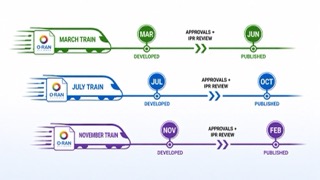
Our technical groups develop multiple specifications in parallel. Three times a year, they package the latest updates and new specifications into a publication train that enters a rigorous approval process: approval within the group, followed by Technical Steering Committee (TSC) approval, a 60-day Intellectual Property Rights (IPR) review period, and final approval from the O-RAN ALLIANCE Board of Directors.
The train approach provides frequent updates allowing agile implementation and ecosystem feedback, making the overall process more reactive. With a predictable pace of three trains per year, O-RAN balances faster innovation with the stability needed for interoperability and ecosystem adoption.
Deliverables from several trains then form an O-RAN release consisting of features defined in technical specifications that are deployable in commercial networks worldwide. Our latest release, O-RAN-R005, was completed with November 2025 publication train – see our previous announcement.
Since then, we have already published specifications from the March 2026 train – check details here.
Now, the July 2026 train has completed development within our technical groups (WGs/FGs) and entered the approval cycle. It contains 67 new or updated technical documents, including new work in:
Following completion of the IPR and Board approval process, the July 2026 train is expected to be published in October 2026 and to become part of the complete O-RAN specification portfolio available at www.o-ran.org/specifications.
Join O-RAN ALLIANCE and collaborate with many industry players on shaping open, intelligent and interoperable RAN. Learn more at www.o-ran.org/membership.

Technical standards are built through contributions, debates and compromises among many companies and organizations from different parts of the world. O-RAN ALLIANCE follows common consensus-driven collaborative process for creating technical specifications, which makes them both robust and widely applicable.
What is unique to the O-RAN ALLIANCE is the publication “train” approach, enabling more efficient specification of new interfaces and functions.
Our technical groups develop multiple specifications in parallel. Three times a year, they package the latest updates and new specifications into a publication train that enters a rigorous approval process: approval within the group, followed by Technical Steering Committee (TSC) approval, a 60-day Intellectual Property Rights (IPR) review period, and final approval from the O-RAN ALLIANCE Board of Directors.
The train approach provides frequent updates allowing agile implementation and ecosystem feedback, making the overall process more reactive. With a predictable pace of three trains per year, O-RAN balances faster innovation with the stability needed for interoperability and ecosystem adoption.
Deliverables from several trains then form an O-RAN release consisting of features defined in technical specifications that are deployable in commercial networks worldwide. Our latest release, O-RAN-R005, was completed with November 2025 publication train – see our previous announcement.
Since then, we have already published specifications from the March 2026 train – check details here.
Now, the July 2026 train has completed development within our technical groups (WGs/FGs) and entered the approval cycle. It contains 67 new or updated technical documents, including new work in:
Following completion of the IPR and Board approval process, the July 2026 train is expected to be published in October 2026 and to become part of the complete O-RAN specification portfolio available at www.o-ran.org/specifications.
Join O-RAN ALLIANCE and collaborate with many industry players on shaping open, intelligent and interoperable RAN. Learn more at www.o-ran.org/membership.


