


Since November 2025, O-RAN ALLIANCE (O-RAN) Work Groups and Focus Groups published 71 technical documents, bringing the total to 147 unique titles. Four documents represent new titles.
All O-RAN technical documents are available for download at www.o-ran.org/specifications.
First version of the stage 3 specification for D2 interface, which specifies C-plane and U-plane aspects.
This specification summarizes the requirements on D2 configuration parameter and PM counter.
This document provides a functional reference architecture of the RAN Fronthaul over Converged Packet Transport Networks.
This document specifies the general aspects, principles, use cases, information model, and requirements pertaining to the format and content of an Application Package which then allows the Network Operator to Onboard the Solution Provider's Application to the SMO through the Onboarding SMOS.
This document describes potential O-RAN use cases at a very high level, emphasizing how the use case is enabled by the O-RAN architecture along with basic input data expectations and resulting actions. This version of O-RAN Use Cases Analysis Report includes addition of two Energy Savings sub-use cases (External power source coordination-based energy saving and PA power optimization-based energy saving) and addition of a clause with void content as placeholder for RAN intent-driven management services use case.
This document describes selected O-RAN use cases in further details to facilitate relevant O-RAN Work Groups to define requirements for associated O-RAN functions and interfaces. This version of O-RAN Use Cases Detailed Specification includes a new use case addition (RAN intent-driven management services), addition of four Energy Savings sub-use cases (RF channel reconfiguration for network energy savings, Advanced Sleep Mode for network energy savings, External power source coordination-based energy saving and PA power optimization-based energy saving), updates to Cell shaping optimization use case and editorial corrections.
The communication and computing integrated networks study (TR) presents the use cases for integrated communication and computing in O-RAN. This version includes a new solution for edge application orchestration on O-Cloud via SMO, enhancing the framework for integrated service provisioning and lifecycle management.
This technical report investigates the various optimization use cases which concern 5G Non-Terrestrial Networks, as well as their coordinated coexistence with 5G Terrestrial Networks. This version has added and updated Intra-NTN Mobility Use Cases.
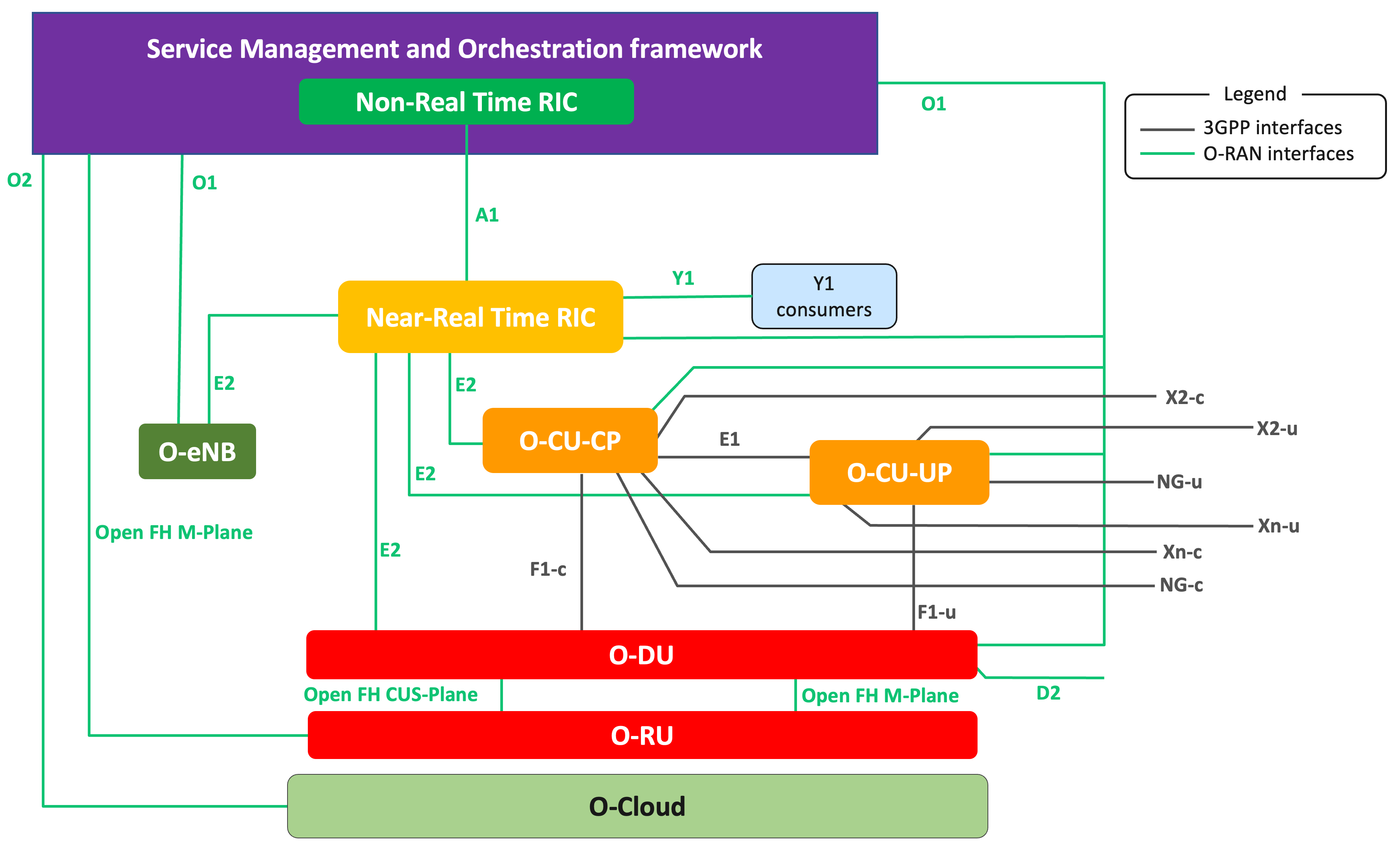
The O-RAN Architecture Description document specifies the overall architecture of O-RAN. It describes all O-RAN architecture elements and relevant interfaces that connect them. This version replaces the detailed figure “SMOSs in the SMO SBA representation” with a higher-level figure “SMO architecture overview”. The associated text has been updated to align with the new figure.
The SMO Architecture specifies the O-RAN SMO architecture. It includes a service-based SMO architecture diagram, and it provides a description of the SMOSs (SMO Services) in the SMO. It also describes aspects such as SMOS Communications, R1 interface and R1 termination, and support for external service/data producers and/or consumers. This version adds an introduction to intent-based network management, introduces the SMO services, and describes the SMO role as southbound interface consumer.
The O-RAN R1GAP Specification summarizes the R1 interface specification objectives and specifies the principles and procedures related to the O-RAN R1 interface. The specification version was published after updating the data registration procedures and the AI/ML model training capability registration services.
This document describes use cases and requirements for the O-RAN R1 interface. This version of the specification has been updated to include the use case for retrieving data jobs from a registered DME type.
This document contains a realization for the procedures identified in O-RAN R1 interface: General Aspects and Principles. This version of the specification is published with the following updates: enhancements to Open APIs to include the SCCL license; modifications to data availability notifications for the Data Access API and the Data Offer API; and updates to the Configuration Schema API to the release version.
This document specifies the Type Definitions for R1 Services. It is part of a TS-family covering the R1 interface specifications. This version of the specification is published with the addition of the SCCL license to the JSON schemas.
This document specifies test cases for conformance testing and interoperability testing of the rApps and R1 services over R1 interface. This version of the specification includes the following test cases:
This document specifies the general aspects and principles of the A1 interface. This version brings updated A1 ML related procedures.
This document specifies the application protocol of the A1 interface. This version brings updated software license statements and definition of A1-ML/v1 (A1 ML model management service).
This specification defines the data types for A1 Policies and A1 Enrichment Information in a reusable and extensible way. It allows new policy types to be created independently of the generic application protocol parts. This version brings updated software license statements.
This document specifies test cases for conformance testing and interoperability testing of the Non-RT RIC and the Near-RT RIC over the A1 interface. This version brings removes negative test cases related to callbacks.
This document describes use cases for the O-RAN A1 interface. This version brings use case for AI/ML model training cancellation.
This document specifies study aimed at exploring the integration of the principles and recommendations of the Decoupled SMO Architecture TR into the WG2 specifications. This version includes WG2 Non-RT RIC architecture, A1, R1, UCR related aspects impact analysis and recommendation.
This document describes O-RAN WG2 Non-RT RIC use cases in detail including the required datasets, the flows, and the interactions within and outside of Non-RT RIC with other O-RAN components. As a result of the use case analysis, this specification captures the requirements imposed by these use cases on the Non-RT RIC architecture, A1 and R1 interfaces as well. This version of the specification includes the addition of four new Energy Savings sub use cases (Spatial and power domain optimization, SSB-less SCell optimization for inter-band CA, PA power optimization for O-RU energy saving, External power source coordination-based energy saving) and updates to address ETSI PAS Review Comments.
This document details the functional and non-functional requirements on Near-RT RIC and E2 interface from the O-RAN use cases under study in O-RAN WG3. This version of the specification includes addition of four Network Energy Saving sub-use cases (Deep hibernate, Spatial and power domain, SSB-less SCell optimization and PA power optimization), addition of descriptions for these sub-use cases to Network energy saving use case and editorial corrections.
The document specifies the general aspects and principles ((incl. services, supported information types, protocol structure) of the Y1 interface, which connects the Near-RT RIC with an authorized Y1 consumer. This version contains editorial improvements and corrections for O-RAN Drafting Rule (ODR) alignment.
The document specifies the application protocols (API definition, solution sets) of the Y1 services. This version contains editorial improvements and corrections for O-RAN Drafting Rule (ODR) alignment.
The document specifies data types that are applicable on the Y1 interface. This version includes enhancement on the granularity of RAN analytics information (RAI), and new attributes for the RAI type “RAN performance analytics”. It also includes editorial revisions to align with O-RAN Drafting Rules (ODR).
The O-RAN Near-RT RIC Architecture TS specifies the Near-RT RIC internal architecture and functionalities, and the stage 2 definitions of Near-RT RIC APIs. This version includes enhancement on E2 Guidance services, simplification for SDL Information service, and O-RAN Drafting Rules (ODR) related corrections and improvements.
The RICAPI document specifies the Near-RT RIC API stage 3 definitions. This version of RICAPI document introduces the definitions for AI/ML APIs, and the definitions for E2 query and E2 subscription modification for E2 Subscription API. This version also integrates various general improvements and corrections, including the removal of SCTP protocol support and the simplification of message table formats.
This document specifies the control plane, user plane and synchronization plane protocols used over the fronthaul interface. The summary of updates for this version is below:
Introduction of new as well as enhancements to existing functionalities, including:
Clarifications, to:
Corrections, to:
Editorial changes and fixes to typographical errors.
This specification defines the Management Plane for the O-RAN Open Fronthaul based on the selected lower-layer split point as defined within the Open Fronthaul Control Plane, User Plane and Synchronization Plane specification. The summary of updates for this version is below.
Addition of new functionality, including:
Clarifications and corrections to v19.00:
This document specifies the interoperability testing (IOT) for O-DU and O-RU from different vendors connected using the O-RAN fronthaul (FH) interface. This version brings:
Addition of new tests, including:
Enhancements and clarifications to v14.00:
This document defines tests that validate the conformance to the protocols defined for the Lower Layer Split Option 7.2x interface between the O-RU and the O-DU. This version brings:
Addition of new test cases, including:
Enhancements and clarifications to v14.00:
The scope of C-Plane profile spec is to further clarify (i.e. profile) for each RAN node the expected behavior (still within the scope of the 3GPP specifications). E.g., Usage of IEs for each use case, general behavior of each node, etc. C-Plane profile spec contains profiles of X2/F1/Xn C-Plane procedure for EN-DC use cases, NR-SA use cases and NR-DC use cases. This version implements 12 CRs for corrections/clarifications on existing use cases.
The scope of WG5 IOT spec is to specify interoperability tests for RAN Node from different vendors implemented in accordance to the WG5 C-plane and U-plane profiles in the specification WG5.C.1. and WG5.U.0, respectively. In this version 10 CRs for new test cases of C-plane profile or correction on existing test cases are implemented.
New specification to specify general aspects and principles for the interface between DUs (D2 interface).
C-plane – fundamental control signaling (D2 setup, UE add./mod./del., etc.) are specified. U-plane – procedure on transferring user data between O-DUs are specified. Synchronization/Transport – specified that existing WG9 requirements and specifications can fulfill the requirement for D2. This version implements CRs for correction/maintenance.
This is first version of the stage 3 specification for D2 interface, which specifies C-plane and U-plane aspects.
This is first version of the specification which summarizes the requirements on D2 configuration parameter and PM counter.
This TS specifies the O-RAN O-Cloud’s DMS interface protocol and data model based on the ETSI NFV solutions. This version of the O2DMS INTERFACE ETSI NFV PROFILE adapts the document to the latest version of the O-RAN TS template. No technical changes have been introduced, and this version only includes editorial corrections and template alignment.
This specification defines O-RAN O-Cloud functions and protocols for the O-RAN O2 interface. This version of the O2 General Aspects and Principles specification adds support for connectivity and timesync, placement, and fixes some editorial issues.
This specification outlines the deployment management services of the O2dms interface profile based on Kubernetes Native API for containerized NFs. This version of the O2dms K8s Profile specification adds support for the following K8s resources, ServiceAccount, Role, and RoleBinding.
FOCOM SMOS Use Cases, covering O-Cloud infrastructure and resources provisioning, O-Cloud performance data collection and monitoring, Software management. Potential requirements introduced for FOCOM SMOS NBI. Recommendations for further analysis related to the FOCOM SMOS NBI Technical Specification. This version of the FOCOM and NFO SMOS technical report adds FOCOM use cases for alarms, logs, and software update.
The O-Cloud Information Model provides the logical model of information elements and their relationships.
This release brings changes to element attributes and inclusion of stage 3 YAML (Open API Specification) files for all namespaces.
This document provides O-Cloud IoT specification, and includes definition of the interoperability testing methodology and a set of tests for the O-Cloud Notification API. This version voids the normative reference [2], [6] and [7].
This specification defines O-RAN O-Cloud IMS interface functions and protocols for the O-RAN O2 interface. This version of the O2ims specification updates the Performance API to add support for PM Jobs, and the Provisioning API for new and updated data types.
This document introduces different use cases for O-RAN orchestration of virtualized RAN and the interfaces used for management and orchestration, in particular the O1 interface between the service management and orchestration framework and the RAN managed functions and the O2 interface between the service management and orchestration framework and the O-Cloud Infrastructure Management Services/Deployment Management Services that controls resource assignment for Virtualized Network Functions. The Cloudification and Orchestration Use Case TS v15.00 incorporates a number of editorial corrections and terminology alignment (such as "Managed Infrastructure Template (MIT)") and new use cases for Provision/Update Resources using MIT, Log Discovery, and WebSocket based PM Streaming Reporting.
This document specifies the hardware reference design as required by architecture and requirements for the Outdoor Microcell and deployment scenario and base station classes specifications. This revision contains Software Defined Radio (SDR) SoC based hardware reference design for Outdoor Micro Cell with split architecture option 7.2.
This specification defines the O-CU and O-DU software architecture, functional blocks, and API definitions. This version brings Massive MIMO (GoB) description update and D2 procedures description update.
This document defines the requirements for an Open Xhaul transport infrastructure. This version adds transport requirements of the D2 interface.
The document is intended to describe best practices for O-RAN Transport Network (TN) based on end-to-end packet switching technology. This version adds a subsection on D2 interface and updates the subsection 9.1 on Physical layout and xHaul transport options. It also adds a section on Applicability of IETF Computing-Aware Traffic Steering (CATS) to O-RAN Scenarios.
This document provides a functional reference architecture of the RAN Fronthaul over Converged Packet Transport Networks.
This document specifies management services for the O-RAN O1 interface and includes requirements, notifications and protocols. Summary of the changes since the previous version:
The O-RAN Information Model and Data Models document specifies the Information Model and the Data Models that are foundational for O-RAN’s model-driven architecture and for the functions carried out over O-RAN interfaces. Summary of the changes since the previous version:
The O-RAN OAM Architecture identifies management services, functions and interfaces supported in O‑RAN, including the interworking between SMO and O-RAN O-Cloud components. Requirements are derived from end-to-end OAM use cases, including the initial provisioning of O-RAN service across VNFs and PNFs and the collection of measurement data. Summary of the changes since the previous version:
The present document specifies the O-RAN Performance Measurements (PMeas) for 5G networks that may be supported on the O1 Interface. This version brings:
This document specifies the Information Model used to support TE&IV services within the SMO. The TE&IV Information Models described in this document are structured using the concept of Namespaces. In addition, relevant sections in this document include information imported from existing standards and industry work that serve as a basis for O-RAN TE&IV. Summary of the changes from the previous version:
This document specifies the TE&IV Data Models used to support TE&IV services within the SMO.
Summary of changes from the previous version:
This document specifies the TE&IV APIs used to support TE&IV services within the SMO. Summary of the changes from the previous version:
The present document specifies the general aspects, principles, use cases, information model, and requirements pertaining to the format and content of an Application Package which then allows the Network Operator to Onboard the Solution Provider's Application to the SMO through the Onboarding SMOS.
These specifications validate the proper implementation of security requirements and protocols, emulate security attacks, and validate the effectiveness of security mitigation methods. The version 12 of the STS document introduces several important security enhancements, including new clauses on MACsec, password policy enforcement (covering default password changes, salted password storage, encrypted client secrets, and O-RU–specific password rules), and expanded controls on unauthorized port behavior, authorization policy enforcement, certificate-verification applicability, SSH key–based authentication, and NACM authorization validation on the Open FH M-plane. Alongside these updates, some content has been removed for simplification or consolidation, specifically the sections on API Consumer, NACM logging monitoring, SSH certificate–based NACM access control, and application image deployment security.
This Technical Specification contains security requirements and controls for O-RAN architecture elements, O-RAN defined interfaces, and transversal security requirements and controls for the O-RAN architecture. The version 14.00 of the technical specification introduces updates to the D2 interface, continuous security monitoring requirements which includes DoS Packet Flooding and unusual resource usage alarms/counters, as well as security requirement for key management for IEEE 1588 Authentication TLV, AAL-specific logging. It mandates TLS 1.3 for Open FH M-Plane, enhances least privilege enforcement, authorization expiration, and refines password controls for all credentials. Security requirements are added for AppLCM software updates, Software Onboarding SMOS verification of software authenticity and integrity, AI/ML model dependency checks, and AI/ML continuous security monitoring. Further updates cover Non-RT RIC, rApps (including ZTA function requirements for data access), O-RU vendor credentials, and shared O-RU NACM support. Requirements and controls for AAL components are updated based on ZTA O-Cloud gap analysis and HAM changes, voiding supply chain controls for AAL. The SBOM clause is refined, and Threats/Security Requirements mappings are added in the Annex D of the specification.
This document provides security protocol specifications for an O-RAN compliant implementation. Version 14.00 of the technical specification updates the AES-GCM related definitions for SSH, fixes a number of errors in the references clause, updates the definition of salts for password protection, introduces the support for OAuth access token expiration and fixes one of the definitions for key exchange algorithm support.
The O-RAN Security Threat Modeling and Risk Assessment Technical Report (TR) identifies critical assets and outlines potential security threats to the O-RAN system, along with guiding security principles to mitigate those risks. It also evaluates the likelihood and potential impact of each identified threat on the overall system. Version 8 enhances the definition of AAL and E2-related assets, introduces new AI/ML threats focusing on evasion attacks along with their risk assessments, and updates the existing AI/ML threat set by explicitly incorporating the associated vulnerabilities.
Security Configuration Management technical report identifies the security YANG models for O-RAN framework fulfilling the security requirements specified and applies to relevant O-RAN interfaces (O1, Open Fronthaul M-plane). It also performs the security gaps related to security configuration such as certificate configuration, NACM configuration and LDAP configuration. The version 02.00 of the SCM TR consists of a security threats analysis for general security configurations, NACM configurations, and LDAP configurations.
The O-RAN Study on Post-Quantum Cryptography is to aid in the migration to Quantum Safe Cryptography (QSC), which essential to ensure the long-term security and resilience of O-RAN networks against potential quantum computer-based attacks. Version 02.00, in addition to minor editorial updates, adds coverage for CMPv2, cryptographic operations as defined in the SPS clause 5, RADIUS and LDAP in the cryptographic inventory.
The Certificate Management Framework Technical Report studies a comprehensive framework for certificate management across the O-RAN environment. Certificate Management Framework Technical Report version 6.0 addresses certificate management for the Shared O-RU.
This technical report provides the threat model and risk assessment for AI/ML in O-RAN. The report identifies threats and risks and recommends potential security controls to protect against those threats through safeguards or mitigations. Version 05.00, in addition to minor editorial updates, changes impact and likelihood defined for T-AIML-SC-06, aligns the asset definition with that of the TMRA, adds assets missing so far and the related asset coverage and adds watermark stripping and model dependency as additional threats.
This technical report studies the applicability of a Zero Trust Architecture (ZTA) to the O-RAN Architecture. It identifies assets and security controls in pursuit of a ZTA while considering those already existing in WG11 specifications. The fifth version of the ZTA technical report continues the maturity assessment based on CISA’s Zero Trust Maturity Model. In this version, gap analysis resolutions towards the Initial maturity stage are added for the Non-RT RIC, rApp, SMO, Open Fronthaul, and O-Cloud. Gap analysis resolutions are in progress for other architecture elements and transversal functions and will be included in later versions of the technical report. Recommendations towards a ZTA are also added to this version.
The Fronthaul CUS-Plane Security Technical Report examines the security aspects of the CUS-Plane on the Open Fronthaul interface between the O-DU and O-RU. It identifies critical assets, key issues, threats, and potential risks, and proposes security requirements and solutions to effectively secure CUS-Plane traffic. Version 06.00 of the technical report includes updated references aligned with O-RAN documentation guidelines and addresses key S-Plane security issues.
This technical report considers the security aspects of the Near-RT RIC platform and xApps, as well as the associated network and management interfaces (E2, A1, O1) and APIs. The study analyzes a list of key issues in the Near-RT RIC overall architecture and proposes solutions in order to derive security requirements. Version 07.00 provides a maintenance update, removing all ‘FFS’ notes and updating the reference clause.
The technical report defines the authorization framework for O-RAN architecture elements using OAuth 2.0 and applies to the HTTP and Kafka based APIs used in the O-RAN interfaces. This TR also performs the security threats for OAuth2.0, key issues & solution use cases (like R1 services). Version 07.00 of the technical report provides additional key issues and use cases related to rApp certificate capabilities as a prerequisite for supporting token binding (RFC 8705).
This technical report documents security analysis for the SMO. The TR provides assets, threats, risk scoring, and recommended security controls for SMO, SMOS, and interfaces. Threat analysis is based upon the STRIDE model and risk scoring is based upon likelihood and impact. The recommended security controls in this TR are used to form normative requirements specified in the SRCS. Version 08.00 of the TR provides updates to align the security analysis with Decoupled SMO architecture, including SMOS. Updated clauses are References, Abbreviations, Assets, Threats, General SMO Threats, and General SMO Risks.
The O-Cloud security technical report analyzes the security of O-Cloud components and interfaces. It includes a risk assessment of the cloud deployment models (Private, Community, Public and Hybrid), identifies the assets that need to be protected, identifies potential security risks and vulnerabilities, and proposes recommendations and best practices for reducing risks and improving the security of O-Cloud. The identified assets, threats and recommendations are intended to be part of O-RAN security related specifications. This version of the TR updates the references clause in the document.
This TR contains a study of continuous security monitoring which was spun off from the zero trust architecture study item. This version of the TR contains additional key issues some related to threats on O‑RU, additional solutions for key issues that were not covered in previous release like API related as well as elaboration on the recommendations which is a step towards normative content.
This document describes the certification and badging processes and associated detailed technical procedures for the Open Testing and Integration Centres (OTICs) and various other testing entities.
Objectives and scope:
Changes from previous version:
This test specification is focused on validating the end-to-end system functionality, performance, and key features of the O-RAN system as a black box. The changes from previous version:

Since November 2025, O-RAN ALLIANCE (O-RAN) Work Groups and Focus Groups published 71 technical documents, bringing the total to 147 unique titles. Four documents represent new titles.
All O-RAN technical documents are available for download at www.o-ran.org/specifications.
First version of the stage 3 specification for D2 interface, which specifies C-plane and U-plane aspects.
This specification summarizes the requirements on D2 configuration parameter and PM counter.
This document provides a functional reference architecture of the RAN Fronthaul over Converged Packet Transport Networks.
This document specifies the general aspects, principles, use cases, information model, and requirements pertaining to the format and content of an Application Package which then allows the Network Operator to Onboard the Solution Provider's Application to the SMO through the Onboarding SMOS.
This document describes potential O-RAN use cases at a very high level, emphasizing how the use case is enabled by the O-RAN architecture along with basic input data expectations and resulting actions. This version of O-RAN Use Cases Analysis Report includes addition of two Energy Savings sub-use cases (External power source coordination-based energy saving and PA power optimization-based energy saving) and addition of a clause with void content as placeholder for RAN intent-driven management services use case.
This document describes selected O-RAN use cases in further details to facilitate relevant O-RAN Work Groups to define requirements for associated O-RAN functions and interfaces. This version of O-RAN Use Cases Detailed Specification includes a new use case addition (RAN intent-driven management services), addition of four Energy Savings sub-use cases (RF channel reconfiguration for network energy savings, Advanced Sleep Mode for network energy savings, External power source coordination-based energy saving and PA power optimization-based energy saving), updates to Cell shaping optimization use case and editorial corrections.
The communication and computing integrated networks study (TR) presents the use cases for integrated communication and computing in O-RAN. This version includes a new solution for edge application orchestration on O-Cloud via SMO, enhancing the framework for integrated service provisioning and lifecycle management.
This technical report investigates the various optimization use cases which concern 5G Non-Terrestrial Networks, as well as their coordinated coexistence with 5G Terrestrial Networks. This version has added and updated Intra-NTN Mobility Use Cases.
The O-RAN Architecture Description document specifies the overall architecture of O-RAN. It describes all O-RAN architecture elements and relevant interfaces that connect them. This version replaces the detailed figure “SMOSs in the SMO SBA representation” with a higher-level figure “SMO architecture overview”. The associated text has been updated to align with the new figure.
The SMO Architecture specifies the O-RAN SMO architecture. It includes a service-based SMO architecture diagram, and it provides a description of the SMOSs (SMO Services) in the SMO. It also describes aspects such as SMOS Communications, R1 interface and R1 termination, and support for external service/data producers and/or consumers. This version adds an introduction to intent-based network management, introduces the SMO services, and describes the SMO role as southbound interface consumer.
The O-RAN R1GAP Specification summarizes the R1 interface specification objectives and specifies the principles and procedures related to the O-RAN R1 interface. The specification version was published after updating the data registration procedures and the AI/ML model training capability registration services.
This document describes use cases and requirements for the O-RAN R1 interface. This version of the specification has been updated to include the use case for retrieving data jobs from a registered DME type.
This document contains a realization for the procedures identified in O-RAN R1 interface: General Aspects and Principles. This version of the specification is published with the following updates: enhancements to Open APIs to include the SCCL license; modifications to data availability notifications for the Data Access API and the Data Offer API; and updates to the Configuration Schema API to the release version.
This document specifies the Type Definitions for R1 Services. It is part of a TS-family covering the R1 interface specifications. This version of the specification is published with the addition of the SCCL license to the JSON schemas.
This document specifies test cases for conformance testing and interoperability testing of the rApps and R1 services over R1 interface. This version of the specification includes the following test cases:
This document specifies the general aspects and principles of the A1 interface. This version brings updated A1 ML related procedures.
This document specifies the application protocol of the A1 interface. This version brings updated software license statements and definition of A1-ML/v1 (A1 ML model management service).
This specification defines the data types for A1 Policies and A1 Enrichment Information in a reusable and extensible way. It allows new policy types to be created independently of the generic application protocol parts. This version brings updated software license statements.
This document specifies test cases for conformance testing and interoperability testing of the Non-RT RIC and the Near-RT RIC over the A1 interface. This version brings removes negative test cases related to callbacks.
This document describes use cases for the O-RAN A1 interface. This version brings use case for AI/ML model training cancellation.
This document specifies study aimed at exploring the integration of the principles and recommendations of the Decoupled SMO Architecture TR into the WG2 specifications. This version includes WG2 Non-RT RIC architecture, A1, R1, UCR related aspects impact analysis and recommendation.
This document describes O-RAN WG2 Non-RT RIC use cases in detail including the required datasets, the flows, and the interactions within and outside of Non-RT RIC with other O-RAN components. As a result of the use case analysis, this specification captures the requirements imposed by these use cases on the Non-RT RIC architecture, A1 and R1 interfaces as well. This version of the specification includes the addition of four new Energy Savings sub use cases (Spatial and power domain optimization, SSB-less SCell optimization for inter-band CA, PA power optimization for O-RU energy saving, External power source coordination-based energy saving) and updates to address ETSI PAS Review Comments.
This document details the functional and non-functional requirements on Near-RT RIC and E2 interface from the O-RAN use cases under study in O-RAN WG3. This version of the specification includes addition of four Network Energy Saving sub-use cases (Deep hibernate, Spatial and power domain, SSB-less SCell optimization and PA power optimization), addition of descriptions for these sub-use cases to Network energy saving use case and editorial corrections.
The document specifies the general aspects and principles ((incl. services, supported information types, protocol structure) of the Y1 interface, which connects the Near-RT RIC with an authorized Y1 consumer. This version contains editorial improvements and corrections for O-RAN Drafting Rule (ODR) alignment.
The document specifies the application protocols (API definition, solution sets) of the Y1 services. This version contains editorial improvements and corrections for O-RAN Drafting Rule (ODR) alignment.
The document specifies data types that are applicable on the Y1 interface. This version includes enhancement on the granularity of RAN analytics information (RAI), and new attributes for the RAI type “RAN performance analytics”. It also includes editorial revisions to align with O-RAN Drafting Rules (ODR).
The O-RAN Near-RT RIC Architecture TS specifies the Near-RT RIC internal architecture and functionalities, and the stage 2 definitions of Near-RT RIC APIs. This version includes enhancement on E2 Guidance services, simplification for SDL Information service, and O-RAN Drafting Rules (ODR) related corrections and improvements.
The RICAPI document specifies the Near-RT RIC API stage 3 definitions. This version of RICAPI document introduces the definitions for AI/ML APIs, and the definitions for E2 query and E2 subscription modification for E2 Subscription API. This version also integrates various general improvements and corrections, including the removal of SCTP protocol support and the simplification of message table formats.
This document specifies the control plane, user plane and synchronization plane protocols used over the fronthaul interface. The summary of updates for this version is below:
Introduction of new as well as enhancements to existing functionalities, including:
Clarifications, to:
Corrections, to:
Editorial changes and fixes to typographical errors.
This specification defines the Management Plane for the O-RAN Open Fronthaul based on the selected lower-layer split point as defined within the Open Fronthaul Control Plane, User Plane and Synchronization Plane specification. The summary of updates for this version is below.
Addition of new functionality, including:
Clarifications and corrections to v19.00:
This document specifies the interoperability testing (IOT) for O-DU and O-RU from different vendors connected using the O-RAN fronthaul (FH) interface. This version brings:
Addition of new tests, including:
Enhancements and clarifications to v14.00:
This document defines tests that validate the conformance to the protocols defined for the Lower Layer Split Option 7.2x interface between the O-RU and the O-DU. This version brings:
Addition of new test cases, including:
Enhancements and clarifications to v14.00:
The scope of C-Plane profile spec is to further clarify (i.e. profile) for each RAN node the expected behavior (still within the scope of the 3GPP specifications). E.g., Usage of IEs for each use case, general behavior of each node, etc. C-Plane profile spec contains profiles of X2/F1/Xn C-Plane procedure for EN-DC use cases, NR-SA use cases and NR-DC use cases. This version implements 12 CRs for corrections/clarifications on existing use cases.
The scope of WG5 IOT spec is to specify interoperability tests for RAN Node from different vendors implemented in accordance to the WG5 C-plane and U-plane profiles in the specification WG5.C.1. and WG5.U.0, respectively. In this version 10 CRs for new test cases of C-plane profile or correction on existing test cases are implemented.
New specification to specify general aspects and principles for the interface between DUs (D2 interface).
C-plane – fundamental control signaling (D2 setup, UE add./mod./del., etc.) are specified. U-plane – procedure on transferring user data between O-DUs are specified. Synchronization/Transport – specified that existing WG9 requirements and specifications can fulfill the requirement for D2. This version implements CRs for correction/maintenance.
This is first version of the stage 3 specification for D2 interface, which specifies C-plane and U-plane aspects.
This is first version of the specification which summarizes the requirements on D2 configuration parameter and PM counter.
This TS specifies the O-RAN O-Cloud’s DMS interface protocol and data model based on the ETSI NFV solutions. This version of the O2DMS INTERFACE ETSI NFV PROFILE adapts the document to the latest version of the O-RAN TS template. No technical changes have been introduced, and this version only includes editorial corrections and template alignment.
This specification defines O-RAN O-Cloud functions and protocols for the O-RAN O2 interface. This version of the O2 General Aspects and Principles specification adds support for connectivity and timesync, placement, and fixes some editorial issues.
This specification outlines the deployment management services of the O2dms interface profile based on Kubernetes Native API for containerized NFs. This version of the O2dms K8s Profile specification adds support for the following K8s resources, ServiceAccount, Role, and RoleBinding.
FOCOM SMOS Use Cases, covering O-Cloud infrastructure and resources provisioning, O-Cloud performance data collection and monitoring, Software management. Potential requirements introduced for FOCOM SMOS NBI. Recommendations for further analysis related to the FOCOM SMOS NBI Technical Specification. This version of the FOCOM and NFO SMOS technical report adds FOCOM use cases for alarms, logs, and software update.
The O-Cloud Information Model provides the logical model of information elements and their relationships.
This release brings changes to element attributes and inclusion of stage 3 YAML (Open API Specification) files for all namespaces.
This document provides O-Cloud IoT specification, and includes definition of the interoperability testing methodology and a set of tests for the O-Cloud Notification API. This version voids the normative reference [2], [6] and [7].
This specification defines O-RAN O-Cloud IMS interface functions and protocols for the O-RAN O2 interface. This version of the O2ims specification updates the Performance API to add support for PM Jobs, and the Provisioning API for new and updated data types.
This document introduces different use cases for O-RAN orchestration of virtualized RAN and the interfaces used for management and orchestration, in particular the O1 interface between the service management and orchestration framework and the RAN managed functions and the O2 interface between the service management and orchestration framework and the O-Cloud Infrastructure Management Services/Deployment Management Services that controls resource assignment for Virtualized Network Functions. The Cloudification and Orchestration Use Case TS v15.00 incorporates a number of editorial corrections and terminology alignment (such as "Managed Infrastructure Template (MIT)") and new use cases for Provision/Update Resources using MIT, Log Discovery, and WebSocket based PM Streaming Reporting.
This document specifies the hardware reference design as required by architecture and requirements for the Outdoor Microcell and deployment scenario and base station classes specifications. This revision contains Software Defined Radio (SDR) SoC based hardware reference design for Outdoor Micro Cell with split architecture option 7.2.
This specification defines the O-CU and O-DU software architecture, functional blocks, and API definitions. This version brings Massive MIMO (GoB) description update and D2 procedures description update.
This document defines the requirements for an Open Xhaul transport infrastructure. This version adds transport requirements of the D2 interface.
The document is intended to describe best practices for O-RAN Transport Network (TN) based on end-to-end packet switching technology. This version adds a subsection on D2 interface and updates the subsection 9.1 on Physical layout and xHaul transport options. It also adds a section on Applicability of IETF Computing-Aware Traffic Steering (CATS) to O-RAN Scenarios.
This document provides a functional reference architecture of the RAN Fronthaul over Converged Packet Transport Networks.
This document specifies management services for the O-RAN O1 interface and includes requirements, notifications and protocols. Summary of the changes since the previous version:
The O-RAN Information Model and Data Models document specifies the Information Model and the Data Models that are foundational for O-RAN’s model-driven architecture and for the functions carried out over O-RAN interfaces. Summary of the changes since the previous version:
The O-RAN OAM Architecture identifies management services, functions and interfaces supported in O‑RAN, including the interworking between SMO and O-RAN O-Cloud components. Requirements are derived from end-to-end OAM use cases, including the initial provisioning of O-RAN service across VNFs and PNFs and the collection of measurement data. Summary of the changes since the previous version:
The present document specifies the O-RAN Performance Measurements (PMeas) for 5G networks that may be supported on the O1 Interface. This version brings:
This document specifies the Information Model used to support TE&IV services within the SMO. The TE&IV Information Models described in this document are structured using the concept of Namespaces. In addition, relevant sections in this document include information imported from existing standards and industry work that serve as a basis for O-RAN TE&IV. Summary of the changes from the previous version:
This document specifies the TE&IV Data Models used to support TE&IV services within the SMO.
Summary of changes from the previous version:
This document specifies the TE&IV APIs used to support TE&IV services within the SMO. Summary of the changes from the previous version:
The present document specifies the general aspects, principles, use cases, information model, and requirements pertaining to the format and content of an Application Package which then allows the Network Operator to Onboard the Solution Provider's Application to the SMO through the Onboarding SMOS.
These specifications validate the proper implementation of security requirements and protocols, emulate security attacks, and validate the effectiveness of security mitigation methods. The version 12 of the STS document introduces several important security enhancements, including new clauses on MACsec, password policy enforcement (covering default password changes, salted password storage, encrypted client secrets, and O-RU–specific password rules), and expanded controls on unauthorized port behavior, authorization policy enforcement, certificate-verification applicability, SSH key–based authentication, and NACM authorization validation on the Open FH M-plane. Alongside these updates, some content has been removed for simplification or consolidation, specifically the sections on API Consumer, NACM logging monitoring, SSH certificate–based NACM access control, and application image deployment security.
This Technical Specification contains security requirements and controls for O-RAN architecture elements, O-RAN defined interfaces, and transversal security requirements and controls for the O-RAN architecture. The version 14.00 of the technical specification introduces updates to the D2 interface, continuous security monitoring requirements which includes DoS Packet Flooding and unusual resource usage alarms/counters, as well as security requirement for key management for IEEE 1588 Authentication TLV, AAL-specific logging. It mandates TLS 1.3 for Open FH M-Plane, enhances least privilege enforcement, authorization expiration, and refines password controls for all credentials. Security requirements are added for AppLCM software updates, Software Onboarding SMOS verification of software authenticity and integrity, AI/ML model dependency checks, and AI/ML continuous security monitoring. Further updates cover Non-RT RIC, rApps (including ZTA function requirements for data access), O-RU vendor credentials, and shared O-RU NACM support. Requirements and controls for AAL components are updated based on ZTA O-Cloud gap analysis and HAM changes, voiding supply chain controls for AAL. The SBOM clause is refined, and Threats/Security Requirements mappings are added in the Annex D of the specification.
This document provides security protocol specifications for an O-RAN compliant implementation. Version 14.00 of the technical specification updates the AES-GCM related definitions for SSH, fixes a number of errors in the references clause, updates the definition of salts for password protection, introduces the support for OAuth access token expiration and fixes one of the definitions for key exchange algorithm support.
The O-RAN Security Threat Modeling and Risk Assessment Technical Report (TR) identifies critical assets and outlines potential security threats to the O-RAN system, along with guiding security principles to mitigate those risks. It also evaluates the likelihood and potential impact of each identified threat on the overall system. Version 8 enhances the definition of AAL and E2-related assets, introduces new AI/ML threats focusing on evasion attacks along with their risk assessments, and updates the existing AI/ML threat set by explicitly incorporating the associated vulnerabilities.
Security Configuration Management technical report identifies the security YANG models for O-RAN framework fulfilling the security requirements specified and applies to relevant O-RAN interfaces (O1, Open Fronthaul M-plane). It also performs the security gaps related to security configuration such as certificate configuration, NACM configuration and LDAP configuration. The version 02.00 of the SCM TR consists of a security threats analysis for general security configurations, NACM configurations, and LDAP configurations.
The O-RAN Study on Post-Quantum Cryptography is to aid in the migration to Quantum Safe Cryptography (QSC), which essential to ensure the long-term security and resilience of O-RAN networks against potential quantum computer-based attacks. Version 02.00, in addition to minor editorial updates, adds coverage for CMPv2, cryptographic operations as defined in the SPS clause 5, RADIUS and LDAP in the cryptographic inventory.
The Certificate Management Framework Technical Report studies a comprehensive framework for certificate management across the O-RAN environment. Certificate Management Framework Technical Report version 6.0 addresses certificate management for the Shared O-RU.
This technical report provides the threat model and risk assessment for AI/ML in O-RAN. The report identifies threats and risks and recommends potential security controls to protect against those threats through safeguards or mitigations. Version 05.00, in addition to minor editorial updates, changes impact and likelihood defined for T-AIML-SC-06, aligns the asset definition with that of the TMRA, adds assets missing so far and the related asset coverage and adds watermark stripping and model dependency as additional threats.
This technical report studies the applicability of a Zero Trust Architecture (ZTA) to the O-RAN Architecture. It identifies assets and security controls in pursuit of a ZTA while considering those already existing in WG11 specifications. The fifth version of the ZTA technical report continues the maturity assessment based on CISA’s Zero Trust Maturity Model. In this version, gap analysis resolutions towards the Initial maturity stage are added for the Non-RT RIC, rApp, SMO, Open Fronthaul, and O-Cloud. Gap analysis resolutions are in progress for other architecture elements and transversal functions and will be included in later versions of the technical report. Recommendations towards a ZTA are also added to this version.
The Fronthaul CUS-Plane Security Technical Report examines the security aspects of the CUS-Plane on the Open Fronthaul interface between the O-DU and O-RU. It identifies critical assets, key issues, threats, and potential risks, and proposes security requirements and solutions to effectively secure CUS-Plane traffic. Version 06.00 of the technical report includes updated references aligned with O-RAN documentation guidelines and addresses key S-Plane security issues.
This technical report considers the security aspects of the Near-RT RIC platform and xApps, as well as the associated network and management interfaces (E2, A1, O1) and APIs. The study analyzes a list of key issues in the Near-RT RIC overall architecture and proposes solutions in order to derive security requirements. Version 07.00 provides a maintenance update, removing all ‘FFS’ notes and updating the reference clause.
The technical report defines the authorization framework for O-RAN architecture elements using OAuth 2.0 and applies to the HTTP and Kafka based APIs used in the O-RAN interfaces. This TR also performs the security threats for OAuth2.0, key issues & solution use cases (like R1 services). Version 07.00 of the technical report provides additional key issues and use cases related to rApp certificate capabilities as a prerequisite for supporting token binding (RFC 8705).
This technical report documents security analysis for the SMO. The TR provides assets, threats, risk scoring, and recommended security controls for SMO, SMOS, and interfaces. Threat analysis is based upon the STRIDE model and risk scoring is based upon likelihood and impact. The recommended security controls in this TR are used to form normative requirements specified in the SRCS. Version 08.00 of the TR provides updates to align the security analysis with Decoupled SMO architecture, including SMOS. Updated clauses are References, Abbreviations, Assets, Threats, General SMO Threats, and General SMO Risks.
The O-Cloud security technical report analyzes the security of O-Cloud components and interfaces. It includes a risk assessment of the cloud deployment models (Private, Community, Public and Hybrid), identifies the assets that need to be protected, identifies potential security risks and vulnerabilities, and proposes recommendations and best practices for reducing risks and improving the security of O-Cloud. The identified assets, threats and recommendations are intended to be part of O-RAN security related specifications. This version of the TR updates the references clause in the document.
This TR contains a study of continuous security monitoring which was spun off from the zero trust architecture study item. This version of the TR contains additional key issues some related to threats on O‑RU, additional solutions for key issues that were not covered in previous release like API related as well as elaboration on the recommendations which is a step towards normative content.
This document describes the certification and badging processes and associated detailed technical procedures for the Open Testing and Integration Centres (OTICs) and various other testing entities.
Objectives and scope:
Changes from previous version:
This test specification is focused on validating the end-to-end system functionality, performance, and key features of the O-RAN system as a black box. The changes from previous version:


