


In the July 2026 specification train, O-RAN ALLIANCE (O-RAN) Work Groups and Focus Groups published 66 new or updated technical documents, bringing the total to 162 unique titles. Five documents represent new titles.
All O-RAN technical documents are available for download at www.o-ran.org/specifications.
This document describes potential O-RAN use cases at a very high level, emphasizing how the use case is enabled by the O-RAN architecture along with basic input data expectations and resulting actions. This version of O-RAN Use Cases Analysis Report includes updates from Release 18 to Release 19 in References clause along with editorial updates.
This document describes selected O-RAN use cases in further details to facilitate relevant O-RAN Work Groups to define requirements for associated O-RAN functions and interfaces. This version of O-RAN Use Cases Detailed Specification includes a new use case addition (Anomaly Management), addition of one sub-use case and its required data to Resiliency use case [Enhanced network resiliency through standby O-DU and adaptive cell activation managed by SMO (O-DU resiliency)], addition of a new solution to Joint communication and computing optimization for V2X communications sub-use case (Compute-aware task scheduling and quality prediction for V2X service continuity), addition of a new solution and its required data to Traffic Steering use case [rApp-based solution for traffic steering use case (O1-based)], additions to Resiliency use case and to RF channel reconfiguration for network energy savings use case, updates to Massive MIMO optimization use case and to Non-RT massive MIMO GoB beam forming optimization use case, updates from Release 18 to Release 19 in References clause and editorial updates.
The SMO Architecture specifies the O-RAN SMO architecture. This revision aligns the specification with Release 19, refines SMOS descriptions for SME and DME, and defines the AI/ML Workflow and PMI SMOSs. It also describes SMOF, adds short names for all SMOSs, deprecates the RAN Analytics SMOS, adds configuration conflict management capability to the RAN NF OAM SMOS, and adds A1 policy conflict management capability to the A1 Related SMOS. Finally, it updates the SMO architecture diagram to reflect all these changes.
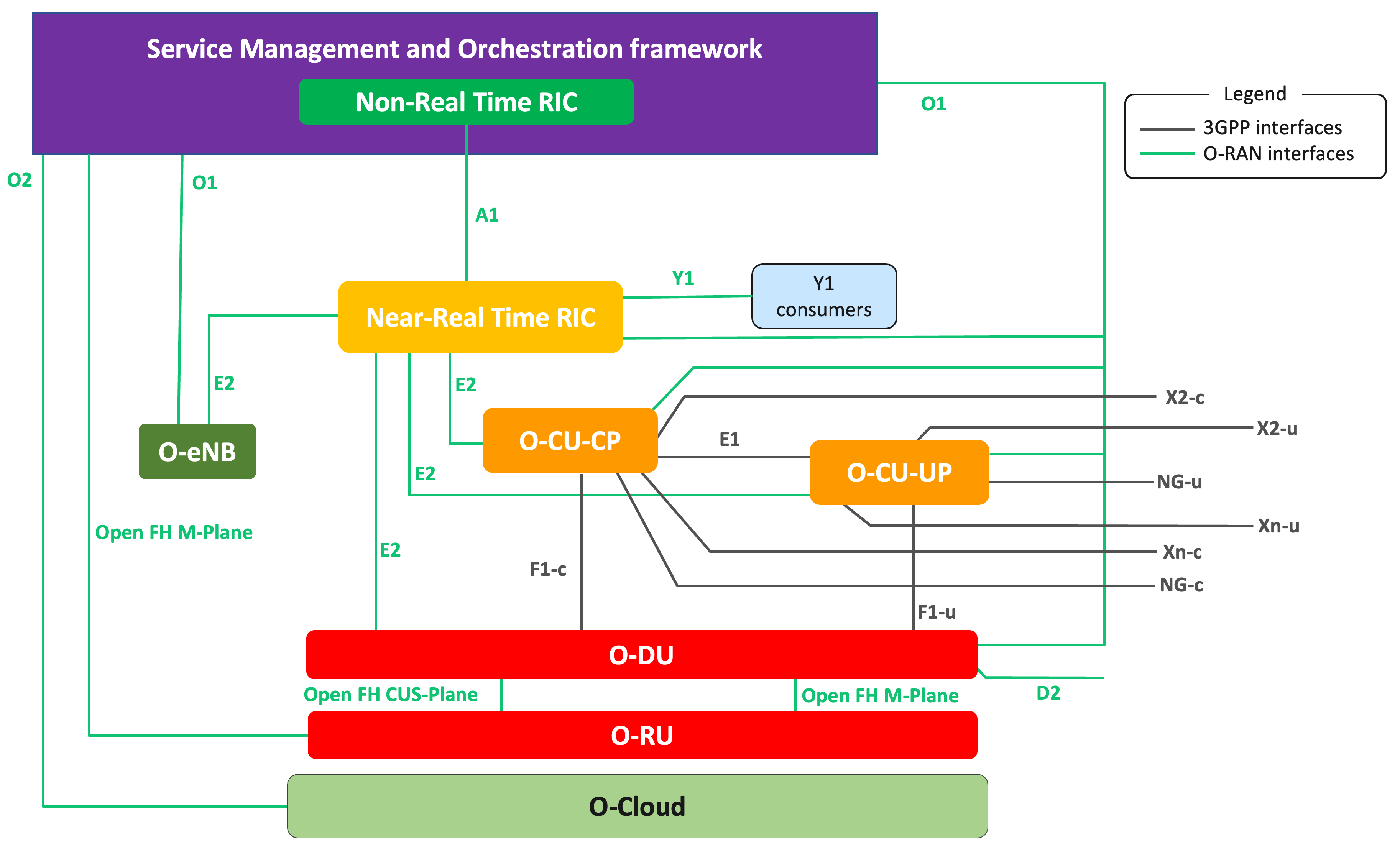
The O-RAN Architecture Description specifies the overall architecture of O-RAN. It describes all O-RAN architecture elements and relevant interfaces that connect them. This version aligns the non-specific 3GPP references to 3GPP Release 19. It also makes editorial corrections to increase accuracy and consistency.
This document specifies the general aspects and principles of the A1 interface. This version brings updated references.
This document describes use cases for the O-RAN A1 interface. This version brings updated references.
This document describes the transport protocol of the O-RAN A1 interface. This version brings updated references.
This document specifies the application protocol of the A1 interface. This version brings updated references.
This specification defines the data types for A1 Policies and A1 Enrichment Information in a reusable and extensible way. It allows new policy types to be created independently of the generic application protocol parts. This version brings updated references.
This document specifies test cases for conformance testing and interoperability testing of the Non-RT RIC and the Near-RT RIC over the A1 interface. This version brings updated introduction and references.
This document contains a realization for the procedures identified in O-RAN R1 interface: General Aspects and Principles. This version of document updated the OpenAPI specifications for the Service Events API, AI/ML model training API, and Data Access API; aligned CAPIF profiling with Release 18; and added new service operations for the AI/ML model performance monitoring API.
This document describes use cases and requirements for the O-RAN R1 interface. This version introduces updates to the DME service requirements, aligns the DME type terminology across R1 UCR and R1 GAP, adds the requirement for notifying changes in data subscription status, and revises the rApp Management service requirements.
The O-RAN R1GAP Specification summarizes the R1 interface specification objectives and specifies the principles and procedures related to the O-RAN R1 interface. This version adopted the 3GPP Release 19 specifications, by updating references and terminology.
This version specifies its scope, principles, use cases, and requirements for DME SMOS , Specifies the use cases related to data registration, data discovery, data offers, data access, delivery, and security.
This document specifies general aspects, business needs, use cases and requirements for the Service Management and Exposure SMOS. Version 1.01 is the result of refactoring to fit the latest template and bugfixing. No new functionality has been defined.
This document specifies the service operations and information models for the Service Management and Exposure SMOS. V 1.00 is the initial version. The content has been developed based on the SME services as defined in the R1 specifications.
This document details the functional and non-functional requirements on Near-RT RIC and E2 interface from the O-RAN use cases under study in O-RAN WG3. This version of the specification includes a new use case addition (NTN Connected Mode Mobility) and updates from Release 18 to Release 19 in References clause.
This document describes E2 Service Model for RAN Control parameters and actions. This version includes support for time and distance based conditional measurement events and NTN handover configurations to support NTN-TN mobility.
This specification defines O-RAN OAM interface functions and protocols for the O-RAN O1 interface for the Near RT RIC. The document studies the functions conveyed over the interface, including management functions, procedures, operations, and corresponding solutions, and identifies existing standards and industry work that can serve as a basis for O-RAN work. This version indicates the deprecation of this TS, as the relevant definitions are transferred to O-RAN WG10 TS.
The O-RAN Near-RT RIC Architecture TS specifies the Near-RT RIC internal architecture and functionalities, and the stage 2 definitions of Near-RT RIC APIs. This version includes enhancements on xApp training service and on the combined use of multiple AI/ML services, general quality improvements on A1 related procedures, and editorial corrections.
This document describes the general aspects and principles of the E2 interface between Near-RT RIC and one or more E2 Nodes, including the interaction with applications hosted in the Near-RT RIC. This version introduces a new procedure for RIC Assistance Cancel and updates the References clause from Release 18 to Release 19.
This document specifies the E2 interface between Near-RT RIC and an E2 Node. This version incorporates a new procedure for RIC Assistance Cancel and a new cause value for duplicated E2 Node IDs, and updates the E2 resource measurement metrics aligned with 3GPP copyright provisions and the References clause from Release 18 to Release 19.
This document describes E2 Service Model for RAN Control parameters and actions. This version incorporates the resolutions for 3GPP copyright alignment and updates the References clause from Release 18 to Release 19.
This document specifies the E2 Service Model (E2SM) for exposing services related to node and cell-level configuration and control over the E2 interface. This version of the E2SM-CCC specification provides clarifications and corrections for O-RU feature-specific capability support and deep hibernate duration parameters and includes editorial updates to accommodate O-RAN software artifact release process.
This document specifies the capabilities exposed over E2 interface to enable efficient control of lower layers of the RAN, including collecting channel and traffic information and controlling the scheduling and precoding parameters. This version includes text changes in preparation for ETSI PAS and compliance with OSARP.
This document specifies the control plane, user plane and synchronization plane protocols used over the fronthaul interface. The summary of updates for this version is below:
This specification defines the Management Plane for the O-RAN Open Fronthaul based on the selected lower-layer split point as defined within the Open Fronthaul Control Plane, User Plane and Synchronization Plane specification. The summary of updates for this version is below.
Addition of new functionality, including:
Clarifications and corrections:
This document defines tests that validate the conformance to the protocols defined for the Lower Layer Split Option 7.2x interface between the O-RU and the O-DU. This version brings:
Addition of new test cases, including:
Changes to existing test cases:
Enhancements and clarifications:
This document specifies the interoperability testing (IOT) for O-DU and O-RU from different vendors connected using the O-RAN fronthaul (FH) interface. This version brings:
NETCONF Notification Collector included as an option during M-Plane Startup tests to observe notifications in the encrypted M-Plane
Clarification and corrections, including:
The scope of C-Plane profile spec is to further clarify (i.e. profile) for each RAN node the expected behavior (still within the scope of the 3GPP specifications). E.g., Usage of IEs for each use case, general behavior of each node, etc. C-Plane profile spec contains profiles of X2/F1/Xn C-Plane procedure for EN-DC use cases, NR-SA use cases and NR-DC use cases. In this version are implemented 4 CRs for corrections/clarifications on existing use cases.
The scope of WG5 IOT spec is to specify interoperability tests for RAN Node from different vendors implemented in accordance to the WG5 C-plane and U-plane profiles in the specification WG5.C.1. and WG5.U.0, respectively. In this version there are CRs for new test cases of C-plane profile or correction on existing test cases are implemented.
Document specifies general aspects and principles for the interface between DUs (D2 interface). C-plane – fundamental control signaling (D2 setup, UE add./mod./del., etc.) are specified. U-plane – procedure on transferring user data between O-DUs are specified. Synchronization/Transport – specified that existing WG9 requirements and specifications can fulfill the requirement for D2. This version brings outcome of the D2 enhancement WI. CRs for editorial corrections are implemented.
This is stage 3 specification for D2 interface, which specifies C-plane and U-plane aspects. This version brings the implementation of CRs for corrections.
This specification summarizes the requirements on D2 configuration parameter and PM counter. This version brings the implementation of CRs for corrections.
This TS specifies the O-RAN O-Cloud’s DMS interface protocol and data model based on the ETSI NFV solutions. This version of the document updates the API versions, in particular the DeploymentLifecycle Servie API, according to the latest available versions and specifications of ETSI NFV Release 5. Referenced versions are also updated accordingly.
This specification defines O-RAN O-Cloud functions and protocols for the O-RAN O2 interface. This version adds energy management overview reasons and optimization, NodeClusterSiteNW and NodeClusterAttachmentDescriptor, Operational Mode set by MIT and PR, and Timing Element concept.
The O-Cloud Information Model provides the logical model of information elements and their relationships.
This version brings: Incorporated a namespaced model for information object classes, updated NodeCluser, InfrastructureResource, NodeClusterSiteNetwork, TimeSync and TimingElement as well as other editorial and terminology corrections
This specification defines O-RAN O-Cloud IMS interface functions and protocols for the O-RAN O2 interface. This version brings PM Subscription Update, Alarm Purge, PM Job Suspend and Alarm Subscription Update.
This document introduces different use cases for O-RAN orchestration of virtualized RAN and the interfaces used for management and orchestration, in particular the O1 interface between the service management and orchestration framework and the RAN managed functions and the O2 interface between the service management and orchestration framework and the O-Cloud Infrastructure Management Services/Deployment Management Services that controls resource assignment for Virtualized Network Functions. The Cloudification and Orchestration Use Case TS v17.00 incorporates new requirements for Logging timestamp format.
This specification defines the O-CU and O-DU software architecture, functional blocks, and API definitions. This version brings the updates of null steering and D2 interface.
This specification defines interoperability test cases for O-CU and O-DU. This version brings new test cases to verify D2 interface Error scenarios.
This document provides a functional reference architecture and nodal requirements for realizing transport services for the O-RAN fronthaul interfaces in converged packet-switching transport networks (CPTN). In this new version the specification has been re-structured to allow for several different solutions and technology options for RAN Fronthaul over CPTN. A first solution covering the option of EVPN over SR-MPLS has been added and a new chapter for synchronization requirements on transport has been included. Figures have also been aligned with the style in other O-RAN specifications.
The Xhaul Packet Switched Architectures and Solutions Technical Specification is intended to describe best practices for O-RAN Transport Network (TN) based on end-to-end packet switching technology. This new version of the specification introduces a new architectural concept: virtual Transport Network Equipment (vTNE). vTNE is introduced to enable Cell Site Router and Hub Site Router functionality as a network function on a virtualized platform. The hosting platform may be x86, GPU, generic CPU, ARM platforms, but not limited.
The document is intended to describe best practices for O-RAN transport Network Element (TNE) management interfaces. This version added appendix G that includes an Approach to define Transport Network Manager Architecture (RMI).
This document specifies management services for the O-RAN O1 interface and includes requirements, notifications and protocols. Changes since the previous version incorporate approved CRs:
The O-RAN Information Model and Data Models document specifies the Information Model and the Data Models that are foundational for O-RAN’s model-driven architecture and for the functions carried out over O-RAN interfaces. This version brings the change of 3GPP references boiler plate text to Rel 19.
The present document specifies the Information Model and the Data Model for Network Resource Model (NRM) that are foundational for functions carried out over the O-RAN O1 interface. This version brings the change of 3GPP references boiler plate text to Rel 19.
The O-RAN OAM Architecture identifies management services, functions and interfaces supported in O‑RAN, including the interworking between SMO and O-RAN O-Cloud components. Requirements are derived from end-to-end OAM use cases, including the initial provisioning of O-RAN service across VNFs and PNFs and the collection of measurement data. Summary of the changes since the previous version:
The present document specifies the O-RAN Performance Measurements (PMeas) for 5G networks that may be supported on the O1 Interface. This version brings:
This document specifies the Information Model used to support TE&IV services within the SMO. The TE&IV Information Models described in this document are structured using the concept of Namespaces. In addition, relevant sections in this document include information imported from existing standards and industry work that serve as a basis for O-RAN TE&IV. Changes since the previous version incorporate approved CRs:
The document specifies the O-RAN Alarms that are reported over the O1 Interface. This version brings:
This document specifies the TE&IV Data Models used to support TE&IV services within the SMO. Changes since the previous version incorporate approved CRs:
The present document specifies the Use Cases, Requirements, General Aspects and Principles of the RAN NF OAM. The initial version incorporate approved CRs for the NFOAM GAPUCR specification:
This Technical Specification contains security requirements and controls for O-RAN architecture elements, O-RAN defined interfaces, and transversal security requirements and controls for the O-RAN architecture.
The version 16.00 of the of the technical specification introduces a comprehensive set of security updates, including corrections to AI/ML security requirements aligned with ETSI TS 104 223 V1.1.1 (2025-04), clarification of network protocol requirement, introduction of new security requirement for private key access logging, trust anchor definition, and API authentication and authorization attack detection counters and alarms within the continuous security monitoring requirements. Additionally, residual risk analysis has been performed across certain O-RAN component and interfaces, and Annex A and Annex D.1 have been updated to reflect the threat mappings to security principles and security requirements to cover Open FH, O-RU, Near-RT RIC, xApp, E2, Y1, A1 and D2. Annex D.1 has also been updated to incorporate OAuth 2.0-related threats to corresponding security requirements mappings.
This document provides security protocol specifications for an O-RAN compliant implementation.
The version 16.00 of the of the technical specification
These specifications validate the proper implementation of security requirements and protocols, emulate security attacks, and validate the effectiveness of security mitigation methods.
Version 14 of the STS document adds explicit secure file-transfer testing for FTPES and SFTP, extending this validation to both the Open Fronthaul M-plane and the O1 interface. It also streamlines several existing TLS, DTLS, IPsec, SSH and interface-security tests by aligning them more closely with applicable 3GPP TS 33.117 procedures, providing a more consistent basis for testing confidentiality, integrity, replay protection and authentication.
Certificate validation is also strengthened with clearer TLS/mTLS applicability and additional negative scenarios, while some overlapping tests are consolidated or removed. Other revisions affect NACM, SCTP, transactional APIs, MACsec, logging, O-DU input validation and several Open Fronthaul, S-plane and O-Cloud test cases.
The O-RAN Security Threat Modeling and Risk Assessment Technical Report (TR) identifies critical assets and outlines potential security threats to the O-RAN system, along with guiding security principles to mitigate those risks. It also evaluates the likelihood and potential impact of each identified threat on the overall system.
Version 10.00 updates the risk matrix to improve alignment with NIST SP 800-30. The updated mapping better reflects the reduction of residual risk when either the impact or likelihood score is reduced. In addition, it provides inherent and residual risk assessments for threats related to Open FH, O-RU, E2, Y1, and D2, considering the applicable security requirements defined in the O-RAN Security Requirements and Controls Specification.
Security Configuration Management technical report identifies the security YANG models for O-RAN framework fulfilling the security requirements specified and applies to relevant O-RAN interfaces (O1, Open Fronthaul M-plane). It also performs the security gaps related to security configuration such as certificate configuration, NACM configuration and LDAP configuration.
The version 03.00 of the of the technical report:
Identifies several key issues related to security configuration management for certificate management, including trust anchors, certificate bags, initial configuration, and the update and removal of security configurations.
The technical report defines the authorization framework for O-RAN architecture elements using OAuth 2.0 and applies to the HTTP and Kafka based APIs used in the O-RAN interfaces. This TR also performs the security threats for OAuth2.0, key issues & solution use cases (like R1 services).
The version 08.00 of the of the technical report:
The O-RAN Study on Post-Quantum Cryptography is to aid in the migration to Quantum Safe Cryptography (QSC), which essential to ensure the long-term security and resilience of O-RAN networks against potential quantum computer-based attacks.
The version 16.00 of the technical report:
The Security Assurance Specification (SCAS) for O-RU defines the security assurance test baseline for the O-RAN Radio Unit. It identifies the security test cases applicable to O-RU products, combining the common baseline test cases from 3GPP TS 33.117 with the O-RAN-specific test cases defined in the O-RAN Security Test Specifications (STS), in order to support verification against the O-RAN Security Requirements and Controls Specification (SRCS).
The SCAS is intended to provide a reusable evaluation reference for O-RU security assurance. It supports the O-RAN Security Certification and Badging Program and may also be leveraged, where adopted, by GSMA NESAS, BSI NESAS, or other telecom security evaluation and certification schemes.
Version 2.00 improves the alignment with 3GPP TS 33.117 by clarifying its role as the common baseline security test specification, restructuring the SCAS to distinguish baseline 3GPP test cases from O-RAN-specific STS test cases, and removing duplicated or equivalent O-RAN test cases.
The Security Assurance Specification (SCAS) for O-DU defines the security assurance test baseline for the O-RAN Distributed Unit. It identifies the security test cases applicable to O-DU products, combining the common baseline test cases from 3GPP TS 33.523 and 3GPP TS 33.117 with the O-RAN-specific test cases defined in the O-RAN Security Test Specifications (STS), in order to support verification against the O-RAN Security Requirements and Controls Specification (SRCS).
The SCAS is intended to provide a reusable evaluation reference for O-DU security assurance. It supports the O-RAN Security Certification and Badging Program and may also be leveraged, where adopted, by GSMA NESAS, BSI NESAS, or other telecom security evaluation and certification schemes.
Version 1.00 establishes the first O-DU SCAS baseline. It defines the applicable security test scope for the O-DU, including its O-RAN and 3GPP-facing interfaces, and identifies the baseline 3GPP and O-RAN-specific STS test cases applicable to O-DU products.
The Security Assurance Specification (SCAS) Versioning and Change Management Process document defines the O-RAN approach for managing SCAS document updates, version control, and alignment with referenced security test documents. It provides the process used to maintain consistency between SCAS documents, the O-RAN Security Test Specifications (STS), and the 3GPP TS 33.117 baseline, while ensuring transparency of changes for users, schemes, test laboratories, and accreditation bodies.
Version 1.00 introduces the initial O-RAN process for SCAS versioning and change management. It defines the rules for the inclusion of STS test cases in SCAS, clarifies the relationship between SCAS, STS, and 3GPP TS 33.117, and explains how substantive and editorial changes are reflected in SCAS updates and version numbering.
This TR contains a study of continuous security monitoring which was spun off from the zero trust architecture study item.
This version of the TR contains additional key issues some related to threats on message delay attacks, additional solutions for solutions like data for API threats, AIML models threats as well as elaboration on the recommendations which is a step towards normative content
This document describes the certification and badging processes and associated detailed technical procedures for the Open Testing and Integration Centres (OTICs) and various other testing entities.
Objectives and scope:
Changes from previous version:
This test specification is focused on validating the end-to-end system functionality, performance, and key features of the O-RAN system as a black box. This version adds beamforming and latency performance test cases in Clause 6, and brings numerous corrections.

In the July 2026 specification train, O-RAN ALLIANCE (O-RAN) Work Groups and Focus Groups published 66 new or updated technical documents, bringing the total to 162 unique titles. Five documents represent new titles.
All O-RAN technical documents are available for download at www.o-ran.org/specifications.
This document describes potential O-RAN use cases at a very high level, emphasizing how the use case is enabled by the O-RAN architecture along with basic input data expectations and resulting actions. This version of O-RAN Use Cases Analysis Report includes updates from Release 18 to Release 19 in References clause along with editorial updates.
This document describes selected O-RAN use cases in further details to facilitate relevant O-RAN Work Groups to define requirements for associated O-RAN functions and interfaces. This version of O-RAN Use Cases Detailed Specification includes a new use case addition (Anomaly Management), addition of one sub-use case and its required data to Resiliency use case [Enhanced network resiliency through standby O-DU and adaptive cell activation managed by SMO (O-DU resiliency)], addition of a new solution to Joint communication and computing optimization for V2X communications sub-use case (Compute-aware task scheduling and quality prediction for V2X service continuity), addition of a new solution and its required data to Traffic Steering use case [rApp-based solution for traffic steering use case (O1-based)], additions to Resiliency use case and to RF channel reconfiguration for network energy savings use case, updates to Massive MIMO optimization use case and to Non-RT massive MIMO GoB beam forming optimization use case, updates from Release 18 to Release 19 in References clause and editorial updates.
The SMO Architecture specifies the O-RAN SMO architecture. This revision aligns the specification with Release 19, refines SMOS descriptions for SME and DME, and defines the AI/ML Workflow and PMI SMOSs. It also describes SMOF, adds short names for all SMOSs, deprecates the RAN Analytics SMOS, adds configuration conflict management capability to the RAN NF OAM SMOS, and adds A1 policy conflict management capability to the A1 Related SMOS. Finally, it updates the SMO architecture diagram to reflect all these changes.
The O-RAN Architecture Description specifies the overall architecture of O-RAN. It describes all O-RAN architecture elements and relevant interfaces that connect them. This version aligns the non-specific 3GPP references to 3GPP Release 19. It also makes editorial corrections to increase accuracy and consistency.
This document specifies the general aspects and principles of the A1 interface. This version brings updated references.
This document describes use cases for the O-RAN A1 interface. This version brings updated references.
This document describes the transport protocol of the O-RAN A1 interface. This version brings updated references.
This document specifies the application protocol of the A1 interface. This version brings updated references.
This specification defines the data types for A1 Policies and A1 Enrichment Information in a reusable and extensible way. It allows new policy types to be created independently of the generic application protocol parts. This version brings updated references.
This document specifies test cases for conformance testing and interoperability testing of the Non-RT RIC and the Near-RT RIC over the A1 interface. This version brings updated introduction and references.
This document contains a realization for the procedures identified in O-RAN R1 interface: General Aspects and Principles. This version of document updated the OpenAPI specifications for the Service Events API, AI/ML model training API, and Data Access API; aligned CAPIF profiling with Release 18; and added new service operations for the AI/ML model performance monitoring API.
This document describes use cases and requirements for the O-RAN R1 interface. This version introduces updates to the DME service requirements, aligns the DME type terminology across R1 UCR and R1 GAP, adds the requirement for notifying changes in data subscription status, and revises the rApp Management service requirements.
The O-RAN R1GAP Specification summarizes the R1 interface specification objectives and specifies the principles and procedures related to the O-RAN R1 interface. This version adopted the 3GPP Release 19 specifications, by updating references and terminology.
This version specifies its scope, principles, use cases, and requirements for DME SMOS , Specifies the use cases related to data registration, data discovery, data offers, data access, delivery, and security.
This document specifies general aspects, business needs, use cases and requirements for the Service Management and Exposure SMOS. Version 1.01 is the result of refactoring to fit the latest template and bugfixing. No new functionality has been defined.
This document specifies the service operations and information models for the Service Management and Exposure SMOS. V 1.00 is the initial version. The content has been developed based on the SME services as defined in the R1 specifications.
This document details the functional and non-functional requirements on Near-RT RIC and E2 interface from the O-RAN use cases under study in O-RAN WG3. This version of the specification includes a new use case addition (NTN Connected Mode Mobility) and updates from Release 18 to Release 19 in References clause.
This document describes E2 Service Model for RAN Control parameters and actions. This version includes support for time and distance based conditional measurement events and NTN handover configurations to support NTN-TN mobility.
This specification defines O-RAN OAM interface functions and protocols for the O-RAN O1 interface for the Near RT RIC. The document studies the functions conveyed over the interface, including management functions, procedures, operations, and corresponding solutions, and identifies existing standards and industry work that can serve as a basis for O-RAN work. This version indicates the deprecation of this TS, as the relevant definitions are transferred to O-RAN WG10 TS.
The O-RAN Near-RT RIC Architecture TS specifies the Near-RT RIC internal architecture and functionalities, and the stage 2 definitions of Near-RT RIC APIs. This version includes enhancements on xApp training service and on the combined use of multiple AI/ML services, general quality improvements on A1 related procedures, and editorial corrections.
This document describes the general aspects and principles of the E2 interface between Near-RT RIC and one or more E2 Nodes, including the interaction with applications hosted in the Near-RT RIC. This version introduces a new procedure for RIC Assistance Cancel and updates the References clause from Release 18 to Release 19.
This document specifies the E2 interface between Near-RT RIC and an E2 Node. This version incorporates a new procedure for RIC Assistance Cancel and a new cause value for duplicated E2 Node IDs, and updates the E2 resource measurement metrics aligned with 3GPP copyright provisions and the References clause from Release 18 to Release 19.
This document describes E2 Service Model for RAN Control parameters and actions. This version incorporates the resolutions for 3GPP copyright alignment and updates the References clause from Release 18 to Release 19.
This document specifies the E2 Service Model (E2SM) for exposing services related to node and cell-level configuration and control over the E2 interface. This version of the E2SM-CCC specification provides clarifications and corrections for O-RU feature-specific capability support and deep hibernate duration parameters and includes editorial updates to accommodate O-RAN software artifact release process.
This document specifies the capabilities exposed over E2 interface to enable efficient control of lower layers of the RAN, including collecting channel and traffic information and controlling the scheduling and precoding parameters. This version includes text changes in preparation for ETSI PAS and compliance with OSARP.
This document specifies the control plane, user plane and synchronization plane protocols used over the fronthaul interface. The summary of updates for this version is below:
This specification defines the Management Plane for the O-RAN Open Fronthaul based on the selected lower-layer split point as defined within the Open Fronthaul Control Plane, User Plane and Synchronization Plane specification. The summary of updates for this version is below.
Addition of new functionality, including:
Clarifications and corrections:
This document defines tests that validate the conformance to the protocols defined for the Lower Layer Split Option 7.2x interface between the O-RU and the O-DU. This version brings:
Addition of new test cases, including:
Changes to existing test cases:
Enhancements and clarifications:
This document specifies the interoperability testing (IOT) for O-DU and O-RU from different vendors connected using the O-RAN fronthaul (FH) interface. This version brings:
NETCONF Notification Collector included as an option during M-Plane Startup tests to observe notifications in the encrypted M-Plane
Clarification and corrections, including:
The scope of C-Plane profile spec is to further clarify (i.e. profile) for each RAN node the expected behavior (still within the scope of the 3GPP specifications). E.g., Usage of IEs for each use case, general behavior of each node, etc. C-Plane profile spec contains profiles of X2/F1/Xn C-Plane procedure for EN-DC use cases, NR-SA use cases and NR-DC use cases. In this version are implemented 4 CRs for corrections/clarifications on existing use cases.
The scope of WG5 IOT spec is to specify interoperability tests for RAN Node from different vendors implemented in accordance to the WG5 C-plane and U-plane profiles in the specification WG5.C.1. and WG5.U.0, respectively. In this version there are CRs for new test cases of C-plane profile or correction on existing test cases are implemented.
Document specifies general aspects and principles for the interface between DUs (D2 interface). C-plane – fundamental control signaling (D2 setup, UE add./mod./del., etc.) are specified. U-plane – procedure on transferring user data between O-DUs are specified. Synchronization/Transport – specified that existing WG9 requirements and specifications can fulfill the requirement for D2. This version brings outcome of the D2 enhancement WI. CRs for editorial corrections are implemented.
This is stage 3 specification for D2 interface, which specifies C-plane and U-plane aspects. This version brings the implementation of CRs for corrections.
This specification summarizes the requirements on D2 configuration parameter and PM counter. This version brings the implementation of CRs for corrections.
This TS specifies the O-RAN O-Cloud’s DMS interface protocol and data model based on the ETSI NFV solutions. This version of the document updates the API versions, in particular the DeploymentLifecycle Servie API, according to the latest available versions and specifications of ETSI NFV Release 5. Referenced versions are also updated accordingly.
This specification defines O-RAN O-Cloud functions and protocols for the O-RAN O2 interface. This version adds energy management overview reasons and optimization, NodeClusterSiteNW and NodeClusterAttachmentDescriptor, Operational Mode set by MIT and PR, and Timing Element concept.
The O-Cloud Information Model provides the logical model of information elements and their relationships.
This version brings: Incorporated a namespaced model for information object classes, updated NodeCluser, InfrastructureResource, NodeClusterSiteNetwork, TimeSync and TimingElement as well as other editorial and terminology corrections
This specification defines O-RAN O-Cloud IMS interface functions and protocols for the O-RAN O2 interface. This version brings PM Subscription Update, Alarm Purge, PM Job Suspend and Alarm Subscription Update.
This document introduces different use cases for O-RAN orchestration of virtualized RAN and the interfaces used for management and orchestration, in particular the O1 interface between the service management and orchestration framework and the RAN managed functions and the O2 interface between the service management and orchestration framework and the O-Cloud Infrastructure Management Services/Deployment Management Services that controls resource assignment for Virtualized Network Functions. The Cloudification and Orchestration Use Case TS v17.00 incorporates new requirements for Logging timestamp format.
This specification defines the O-CU and O-DU software architecture, functional blocks, and API definitions. This version brings the updates of null steering and D2 interface.
This specification defines interoperability test cases for O-CU and O-DU. This version brings new test cases to verify D2 interface Error scenarios.
This document provides a functional reference architecture and nodal requirements for realizing transport services for the O-RAN fronthaul interfaces in converged packet-switching transport networks (CPTN). In this new version the specification has been re-structured to allow for several different solutions and technology options for RAN Fronthaul over CPTN. A first solution covering the option of EVPN over SR-MPLS has been added and a new chapter for synchronization requirements on transport has been included. Figures have also been aligned with the style in other O-RAN specifications.
The Xhaul Packet Switched Architectures and Solutions Technical Specification is intended to describe best practices for O-RAN Transport Network (TN) based on end-to-end packet switching technology. This new version of the specification introduces a new architectural concept: virtual Transport Network Equipment (vTNE). vTNE is introduced to enable Cell Site Router and Hub Site Router functionality as a network function on a virtualized platform. The hosting platform may be x86, GPU, generic CPU, ARM platforms, but not limited.
The document is intended to describe best practices for O-RAN transport Network Element (TNE) management interfaces. This version added appendix G that includes an Approach to define Transport Network Manager Architecture (RMI).
This document specifies management services for the O-RAN O1 interface and includes requirements, notifications and protocols. Changes since the previous version incorporate approved CRs:
The O-RAN Information Model and Data Models document specifies the Information Model and the Data Models that are foundational for O-RAN’s model-driven architecture and for the functions carried out over O-RAN interfaces. This version brings the change of 3GPP references boiler plate text to Rel 19.
The present document specifies the Information Model and the Data Model for Network Resource Model (NRM) that are foundational for functions carried out over the O-RAN O1 interface. This version brings the change of 3GPP references boiler plate text to Rel 19.
The O-RAN OAM Architecture identifies management services, functions and interfaces supported in O‑RAN, including the interworking between SMO and O-RAN O-Cloud components. Requirements are derived from end-to-end OAM use cases, including the initial provisioning of O-RAN service across VNFs and PNFs and the collection of measurement data. Summary of the changes since the previous version:
The present document specifies the O-RAN Performance Measurements (PMeas) for 5G networks that may be supported on the O1 Interface. This version brings:
This document specifies the Information Model used to support TE&IV services within the SMO. The TE&IV Information Models described in this document are structured using the concept of Namespaces. In addition, relevant sections in this document include information imported from existing standards and industry work that serve as a basis for O-RAN TE&IV. Changes since the previous version incorporate approved CRs:
The document specifies the O-RAN Alarms that are reported over the O1 Interface. This version brings:
This document specifies the TE&IV Data Models used to support TE&IV services within the SMO. Changes since the previous version incorporate approved CRs:
The present document specifies the Use Cases, Requirements, General Aspects and Principles of the RAN NF OAM. The initial version incorporate approved CRs for the NFOAM GAPUCR specification:
This Technical Specification contains security requirements and controls for O-RAN architecture elements, O-RAN defined interfaces, and transversal security requirements and controls for the O-RAN architecture.
The version 16.00 of the of the technical specification introduces a comprehensive set of security updates, including corrections to AI/ML security requirements aligned with ETSI TS 104 223 V1.1.1 (2025-04), clarification of network protocol requirement, introduction of new security requirement for private key access logging, trust anchor definition, and API authentication and authorization attack detection counters and alarms within the continuous security monitoring requirements. Additionally, residual risk analysis has been performed across certain O-RAN component and interfaces, and Annex A and Annex D.1 have been updated to reflect the threat mappings to security principles and security requirements to cover Open FH, O-RU, Near-RT RIC, xApp, E2, Y1, A1 and D2. Annex D.1 has also been updated to incorporate OAuth 2.0-related threats to corresponding security requirements mappings.
This document provides security protocol specifications for an O-RAN compliant implementation.
The version 16.00 of the of the technical specification
These specifications validate the proper implementation of security requirements and protocols, emulate security attacks, and validate the effectiveness of security mitigation methods.
Version 14 of the STS document adds explicit secure file-transfer testing for FTPES and SFTP, extending this validation to both the Open Fronthaul M-plane and the O1 interface. It also streamlines several existing TLS, DTLS, IPsec, SSH and interface-security tests by aligning them more closely with applicable 3GPP TS 33.117 procedures, providing a more consistent basis for testing confidentiality, integrity, replay protection and authentication.
Certificate validation is also strengthened with clearer TLS/mTLS applicability and additional negative scenarios, while some overlapping tests are consolidated or removed. Other revisions affect NACM, SCTP, transactional APIs, MACsec, logging, O-DU input validation and several Open Fronthaul, S-plane and O-Cloud test cases.
The O-RAN Security Threat Modeling and Risk Assessment Technical Report (TR) identifies critical assets and outlines potential security threats to the O-RAN system, along with guiding security principles to mitigate those risks. It also evaluates the likelihood and potential impact of each identified threat on the overall system.
Version 10.00 updates the risk matrix to improve alignment with NIST SP 800-30. The updated mapping better reflects the reduction of residual risk when either the impact or likelihood score is reduced. In addition, it provides inherent and residual risk assessments for threats related to Open FH, O-RU, E2, Y1, and D2, considering the applicable security requirements defined in the O-RAN Security Requirements and Controls Specification.
Security Configuration Management technical report identifies the security YANG models for O-RAN framework fulfilling the security requirements specified and applies to relevant O-RAN interfaces (O1, Open Fronthaul M-plane). It also performs the security gaps related to security configuration such as certificate configuration, NACM configuration and LDAP configuration.
The version 03.00 of the of the technical report:
Identifies several key issues related to security configuration management for certificate management, including trust anchors, certificate bags, initial configuration, and the update and removal of security configurations.
The technical report defines the authorization framework for O-RAN architecture elements using OAuth 2.0 and applies to the HTTP and Kafka based APIs used in the O-RAN interfaces. This TR also performs the security threats for OAuth2.0, key issues & solution use cases (like R1 services).
The version 08.00 of the of the technical report:
The O-RAN Study on Post-Quantum Cryptography is to aid in the migration to Quantum Safe Cryptography (QSC), which essential to ensure the long-term security and resilience of O-RAN networks against potential quantum computer-based attacks.
The version 16.00 of the technical report:
The Security Assurance Specification (SCAS) for O-RU defines the security assurance test baseline for the O-RAN Radio Unit. It identifies the security test cases applicable to O-RU products, combining the common baseline test cases from 3GPP TS 33.117 with the O-RAN-specific test cases defined in the O-RAN Security Test Specifications (STS), in order to support verification against the O-RAN Security Requirements and Controls Specification (SRCS).
The SCAS is intended to provide a reusable evaluation reference for O-RU security assurance. It supports the O-RAN Security Certification and Badging Program and may also be leveraged, where adopted, by GSMA NESAS, BSI NESAS, or other telecom security evaluation and certification schemes.
Version 2.00 improves the alignment with 3GPP TS 33.117 by clarifying its role as the common baseline security test specification, restructuring the SCAS to distinguish baseline 3GPP test cases from O-RAN-specific STS test cases, and removing duplicated or equivalent O-RAN test cases.
The Security Assurance Specification (SCAS) for O-DU defines the security assurance test baseline for the O-RAN Distributed Unit. It identifies the security test cases applicable to O-DU products, combining the common baseline test cases from 3GPP TS 33.523 and 3GPP TS 33.117 with the O-RAN-specific test cases defined in the O-RAN Security Test Specifications (STS), in order to support verification against the O-RAN Security Requirements and Controls Specification (SRCS).
The SCAS is intended to provide a reusable evaluation reference for O-DU security assurance. It supports the O-RAN Security Certification and Badging Program and may also be leveraged, where adopted, by GSMA NESAS, BSI NESAS, or other telecom security evaluation and certification schemes.
Version 1.00 establishes the first O-DU SCAS baseline. It defines the applicable security test scope for the O-DU, including its O-RAN and 3GPP-facing interfaces, and identifies the baseline 3GPP and O-RAN-specific STS test cases applicable to O-DU products.
The Security Assurance Specification (SCAS) Versioning and Change Management Process document defines the O-RAN approach for managing SCAS document updates, version control, and alignment with referenced security test documents. It provides the process used to maintain consistency between SCAS documents, the O-RAN Security Test Specifications (STS), and the 3GPP TS 33.117 baseline, while ensuring transparency of changes for users, schemes, test laboratories, and accreditation bodies.
Version 1.00 introduces the initial O-RAN process for SCAS versioning and change management. It defines the rules for the inclusion of STS test cases in SCAS, clarifies the relationship between SCAS, STS, and 3GPP TS 33.117, and explains how substantive and editorial changes are reflected in SCAS updates and version numbering.
This TR contains a study of continuous security monitoring which was spun off from the zero trust architecture study item.
This version of the TR contains additional key issues some related to threats on message delay attacks, additional solutions for solutions like data for API threats, AIML models threats as well as elaboration on the recommendations which is a step towards normative content
This document describes the certification and badging processes and associated detailed technical procedures for the Open Testing and Integration Centres (OTICs) and various other testing entities.
Objectives and scope:
Changes from previous version:
This test specification is focused on validating the end-to-end system functionality, performance, and key features of the O-RAN system as a black box. This version adds beamforming and latency performance test cases in Clause 6, and brings numerous corrections.


