


Since July 2025, O-RAN ALLIANCE (O-RAN) Work Groups and Focus Groups published 76 technical documents, bringing the total to 143 unique titles in current version and 946 documents overall. Nine documents represent new titles.
All O-RAN technical documents are available for download at www.o-ran.org/specifications.
This technical report presents the analysis and use cases for resiliency in O-RAN. The various failure scenarios and potential solutions are studied for the identified use cases. The technical report also identifies the potential impacts and requirements on various interfaces and components of O-RAN architecture to support the resiliency in O-RAN.
This technical report investigates the various optimization use cases which concern 5G Non-Terrestrial Networks, as well as their coordinated coexistence with 5G Terrestrial Networks. The various use cases are carefully motivated with their respective impacts, requirements, and proposed approaches for their realization, resulting in the recognition of enhancements needed to the O-RAN architecture and constituent interfaces.
This technical report presents the key requirements and potential solutions for Filtered Measurements in O-RAN, based on the current state and limitations of measurement data filtering in O-RAN. In addition, use cases are investigated to identify the benefits of Filtered Measurements in different scenarios.
This document specifies the O-RAN SMO architecture. It includes a service-based SMO architecture diagram, and it provides a description of the SMOSs (SMO Services) in the SMO. It also describes aspects such as SMOS Communications, R1 interface and R1 termination, and support for external service/data producers and/or consumers.
This document specifies study aimed at exploring the integration of the principles and recommendations of the Decoupled SMO Architecture Technical Report into the WG2 specifications. This version includes WG2 Non-RT RIC architecture, A1, R1, UCR related aspects impact analysis and recommendation.
This document introduces FOCOM SMOS Use Cases, covering O-Cloud infrastructure and resources provisioning, O-Cloud performance data collection and monitoring, and Software management. Potential requirements are introduced for FOCOM SMOS NBI. It includes recommendations for further analysis related to the FOCOM SMOS NBI Technical Specification.
This Technical Report studies the data formats, management operations, and telemetry transport mechanisms for OAM from a cloud-native perspective.
This Technical Report identifies the security YANG models for O-RAN framework fulfilling the security requirements specified and applied to relevant O-RAN interfaces (O1, Open Fronthaul M-plane). It also covers security gaps related to security configuration such as certificate configuration, NACM configuration and LDAP configuration. This version introduces the scope, background and considerations for the SCM TR. It also updates the Assets, Security controls and Security threats which are considered for the SCM TR.
The O-RAN Study on Post-Quantum Cryptography is to aid in the migration to Quantum Safe Cryptography (QSC), which is essential to ensure the long-term security and resilience of O-RAN networks against potential quantum computer-based attacks. Version 01.00 contains a cryptographic inventory, covering all cryptographic algorithms employed in O-RAN specification at this time.
This document describes potential O-RAN use cases at a very high level, emphasizing how the use case is enabled by the O-RAN architecture along with basic input data expectations and resulting actions. This version of O-RAN Use Cases Analysis Report includes updates to a new use case addition (CCIN) and some editorial updates.
This document describes selected O-RAN use cases in further details to facilitate relevant O-RAN Work Groups to define requirements for associated O-RAN functions and interfaces. This version of O-RAN Use Cases Detailed Specification Report includes a new use case addition (CCIN), addition of a sub use case (Cell Shaping Optimization – Massive MIMO) and requirements related improvements to two use cases (RAN Slice SLA Assurance, Energy Savings).
This technical report presents the analysis and use cases for resiliency in O-RAN. The various failure scenarios and potential solutions are studied for the identified use cases. The technical report also identifies the potential impacts and requirements on various interfaces and components of O-RAN architecture to support the resiliency in O-RAN.
This technical report investigates the various optimization use cases which concern 5G Non-Terrestrial Networks, as well as their coordinated coexistence with 5G Terrestrial Networks. The various use cases are carefully motivated with their respective impacts, requirements, and proposed approaches for their realization, resulting in the recognition of enhancements needed to the O-RAN architecture and constituent interfaces.
This technical report presents the key requirements and potential solutions for Filtered Measurements in O-RAN, based on the current state and limitations of measurement data filtering in O-RAN. In addition, use cases are investigated to identify the benefits of Filtered Measurements in different scenarios.
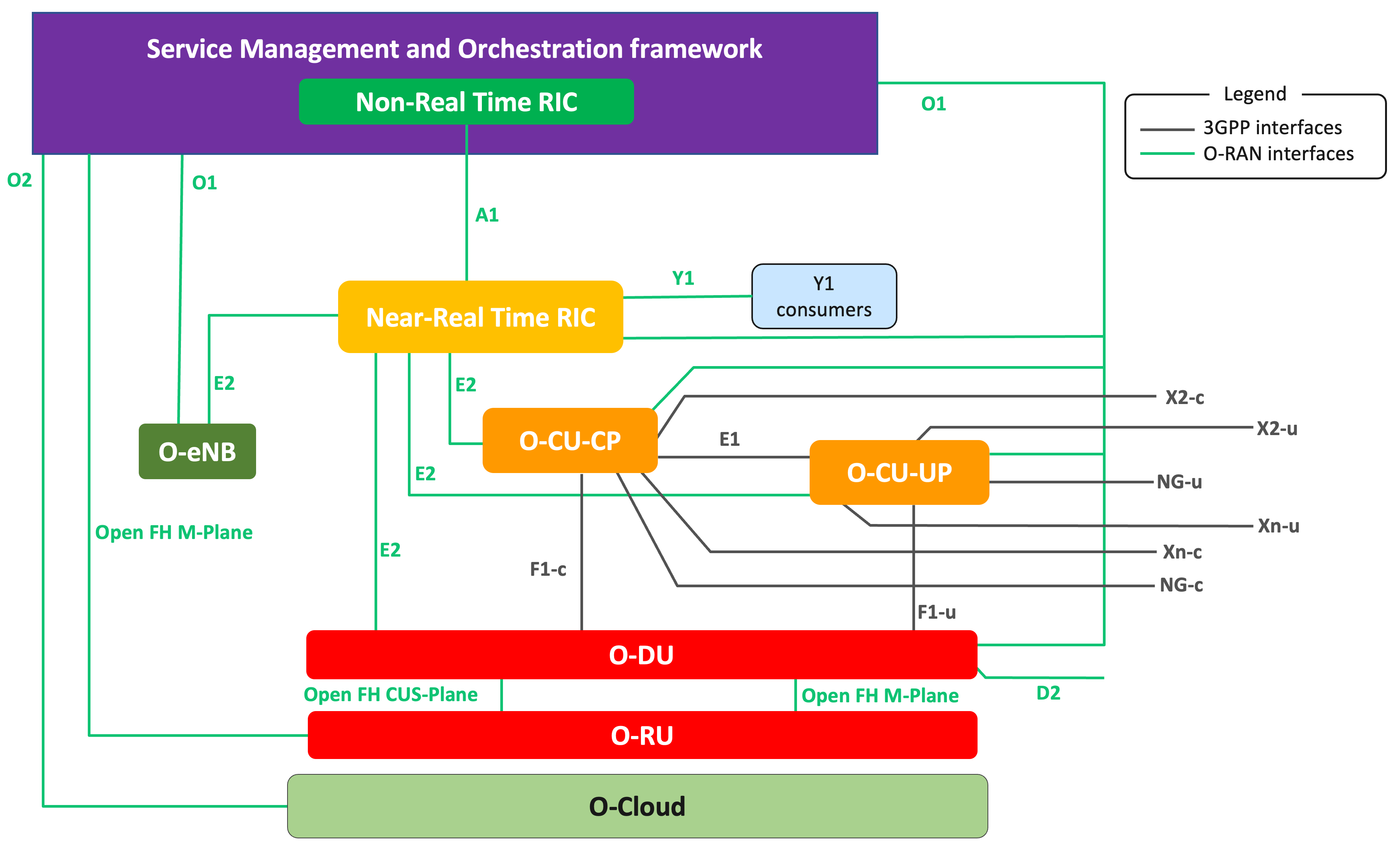
The O-RAN Architecture Description document specifies the overall architecture of O-RAN. It describes all O-RAN architecture elements and relevant interfaces that connect them. This version adds the definition “R1 Services” while showing the “R1 interface” and “R1 Termination” in SBA representation of SMOSs. It states that “SMO” and “SMO framework” are used interchangeably, and to reflect that the “Service Management and Orchestration Framework” is changed to “Service Management and Orchestration framework”. Finally, it adds support for SMO consumption of external service/data producers.
The SMO Architecture specifies the O-RAN SMO architecture. It includes a service-based SMO architecture diagram, and it provides a description of the SMOSs (SMO Services) in the SMO. It also describes aspects such as SMOS Communications, R1 interface and R1 termination, and support for external service/data producers and/or consumers.
The SMO Intents-driven Management TR introduces the exposure of SMO Services (SMOSs) in a simplified form - i.e., RAN management via intents - to address the wide range of their applicability. This includes the various interactions within SMO management loops (closed, open), serving as a simplified method for management exposure of RAN services both externally and internally to other management or business systems. This version adds an example of RMIH (RAN Management Intent Handler) and RMIO (RAN Management Intent Owner) placement within the SMO without limiting which SMOS producers can realize RMIHs.
This document specifies study aimed at exploring the integration of the principles and recommendations of the Decoupled SMO Architecture TR into the WG2 specifications. This version includes WG2 Non-RT RIC architecture, A1, R1, UCR related aspects impact analysis and recommendation.
This document describes O-RAN WG2 Non-RT RIC use cases in detail including the required datasets, the flows, and the interactions within and outside of Non-RT RIC with other O-RAN components. As a result of the use case analysis, this specification captures the requirements imposed by these use cases on the Non-RT RIC architecture, A1 and R1 interfaces as well. This version of the specification includes the updates to address ETSI PAS review comments.
This document describes use cases and requirements for the O-RAN R1 interface. This specification updates the rApp registration use case from SME to rApp management, revises the AI/ML training capability use case, and aligns the specification with TS template version 05.
This document contains a realization for the procedures identified in O-RAN R1 interface: General Aspects and Principles. The specification updates the Configuration Management API, Data Registration API, Configuration Schema API, and AI/ML Model Discovery API. The clause for the AI/ML Model Retrieve API has been voided, and the specification has been aligned with TS template version 05.
The O-RAN R1GAP Specification summarizes the R1 interface specification objectives and specifies the principles and procedures related to the O-RAN R1 interface. The specification version was published by updating the rApp registration from SME to rApp management services.
This document specifies test cases for conformance testing and interoperability testing of the rApps and R1 services over R1 interface. This specification was published along with conformance tests for the rApp and Non-RT RIC as Devices Under Test (DUT). The tests cover Data Offer test cases, Bootstrap test case, AI/ML Model Discovery test case, AI/ML Model Registration test case, and Configuration Management test case for the rApp as DUT.
This document specifies the general aspects and principles of the A1 interface. This version applies the latest O-RAN TS Template.
This document describes use cases for the O-RAN A1 interface. This version brings Use case for AI/ML model training capabilities discovery.
This document describes the transport protocol of the O-RAN A1 interface. This version applies the latest O-RAN TS Template.
This document specifies test cases for conformance testing and interoperability testing of the Non-RT RIC and the Near-RT RIC over the A1 interface. This version applies the latest O-RAN TS Template and brings editorial enhancements.
This document specifies the application protocol of the A1 interface. This version applies the latest O-RAN TS Template and brings editorial enhancement and introduction of A1-ML service operations and resources.
This specification defines the data types for A1 Policies and A1 Enrichment Information in a reusable and extensible way. It allows new policy types to be created independently of the generic application protocol parts. This version applies the latest O-RAN TS Template and brings updates to the common schema and the policy and EI types related to that and updates to the Load balancing policy type.
This document describes the general aspects and principles of the E2 interface between Near-RT RIC and one or more E2 Nodes, including the interaction with applications hosted in the Near-RT RIC. This version includes support for ASSISTANCE service capability exposure during E2 Setup and RIC service update procedures.
This document specifies the E2 interface between Near-RT RIC and an E2 Node. This version includes support for E2 resource status reporting feature, and ASSISTANCE service capability exposure during E2 Setup and RIC service update procedures.
This document specifies the E2 Service Model (E2SM) “Key Performance Measurement” (KPM) for the RAN function. This version of E2SM-KPM includes a new event style for supporting Measurement-based "Event" reporting, correction for the Integrated REPORT Service style 255 and some editorial updates.
This document describes E2 Service Model for RAN Control parameters and actions. This version includes support for Control action to add, modify and delete the Cell Switch Restriction List for Connected Mode Mobility Control.
This document details the functional and non-functional requirements on Near-RT RIC and E2 interface from the O-RAN use cases under study in O-RAN WG3. This version of WG3 Use Case Requirements specification includes a new use case (Interference Detection and Optimization) and some editorial updates.
This document specifies the control plane, user plane and synchronization plane protocols used over the fronthaul interface. The summary of updates for this version is below:
Introduction of new functionalities, including:
Clarifications, of:
Corrections, to:
Editorial improvements and fixes to typographical errors.
This specification defines the Management Plane for the O-RAN Open Fronthaul based on the selected lower-layer split point as defined within the Open Fronthaul Control Plane, User Plane and Synchronization Plane specification. The summary of updates for this version is below.
Addition of new functionality, including:
Clarifications and corrections to v18.00:
This document defines tests that validate the conformance to the protocols defined for the Lower Layer Split Option 7.2x interface between the O-RU and the O-DU. This version brings:
Addition of new test cases, including:
Enhancements and clarifications to v13.00:
This document specifies the interoperability testing (IOT) for O-DU and O-RU from different vendors connected using the O-RAN fronthaul (FH) interface. This version brings:
Addition of new tests and profiles, including:
Enhancements and clarifications to v13.00:
The scope of C-Plane profile spec is to further clarify (i.e. profile) for each RAN node the expected behavior (still within the scope of the 3GPP specifications). E.g., Usage of IEs for each use case, general behavior of each node, etc. C-Plane profile spec contains profiles of X2/F1/Xn C-Plane procedure for EN-DC use cases, NR-SA use cases and NR-DC use cases. This version implements 11 CRs for corrections/clarifications on existing use cases.
The scope of WG5 IOT spec is to specify interoperability tests for RAN Node from different vendors implemented in accordance to the WG5 C-plane and U-plane profiles in the specification WG5.C.1. and WG5.U.0, respectively. This version implements 11 new test cases for C-plane profile and corrects 1 existing use case.
New specification to specify general aspects and principles for the interface between DUs (D2 interface).
C-plane – fundamental control signaling (D2 setup, UE add./mod./del., etc.) are specified. U-plane – procedure on transferring user data between O-DUs are specified. Synchronization/Transport – specified that existing WG9 requirements and specifications can fulfill the requirement for D2. This version implements 3 CRs to capture the agreement on HARQ process and clarifications for the existing description.
This document specifies a test specification for test and validation of the O-Cloud interfaces/APIs. This is a minor but important update to comply with the newest ETSI NFV profile standards. This release will ensure that the DMS (Data Management System) is configured to support the updated specifications, ensuring full compatibility and optimal performance.
The scope of the O-RAN Study on O-Cloud Energy Savings is to investigate, review and further specify WG6 O-Cloud energy saving related use cases, requirements, and potential impact on the O-Cloud O2 interface, for example O2ims and O2dms. This is an important update aligned with the latest progress in O-RAN WG6 Energy Savings standardization work. This release finalizes the O-RAN.WG6.O-CLOUD-ES TR v02.00.05 by removing Section 7, "Recommendations," and revising Section 8, ensuring the document reflects the most current direction of the WG6 Energy Savings technical report.
This specification defines O-RAN O-Cloud functions and protocols for the O-RAN O2 interface. This version of the document updates the Cluster Template to Managed Infrastructure Template (MIT) including further detail to define the concept. Additional updates have been made related to the DMS, O-Cloud Platform, Cluster Capabilities, and Time Synchronisation.
The O-Cloud Information Model provides the logical model of information elements and their relationships.
This release provides needed updates to align with service model changes for Notification File Ready, Log Query, PM Job Change Notifications and Provisioning Requests. Additional changes to make Fault reporting available for elements in domains other than the Infrastructure Inventory namespace.
This document provides O-Cloud IoT specification, and includes definition of the interoperability testing methodology and a set of tests for the O-Cloud Notification API. This version included the O2 IMS IOT SUT requirements and test tool configurations in the section 7.3 and Update the normative references section to include WG6 Orchestration use spec[12] and WG6 Conformance IOT spec[13].
FOCOM SMOS Use Cases, covering O-Cloud infrastructure and resources provisioning, O-Cloud performance data collection and monitoring, Software management. Potential requirements introduced for FOCOM SMOS NBI. Recommendations for further analysis related to the FOCOM SMOS NBI Technical Specification.
This specification defines O-RAN O-Cloud IMS interface functions and protocols for the O-RAN O2 interface. This version of the document introduces a major update to the following APIs, O2ims_InfrastructureInventory Service API, O2ims_InfrastructureMonitoring Service API, and O2ims_InfrastructurePerformance Service API. There are also updates to the Provisioning API, O-Cloud Alarms, and Security information.
This document introduces different use cases for O-RAN orchestration of virtualized RAN and the interfaces used for management and orchestration, in particular the O1 interface between the service management and orchestration framework and the RAN managed functions and the O2 interface between the service management and orchestration framework and the O-Cloud Infrastructure Management Services/Deployment Management Services that controls resource assignment for Virtualized Network Functions. The Cloudification and Orchestration Use Case TS v14.00 incorporates a number of corrections of terminologies and new use cases for Provision/Update Infrastructure Resources using Template, Provision Networking Infrastructure using Template, and Discover O-Cloud Cluster Template.
This specification focuses on the Common API related to common aspects of accelerator abstraction from an administration and AAL Application perspective. This version introduces a declarative approach for configuring an accelerator using templates. Chapter 6 was added to the spec for configuring accelerators with Declarative approach.
This specification defines O-RAN O-Cloud hardware accelerator interface functions and protocols for the O-RAN AAL interface. This release updates the architecture diagram in the GAnP to reflect the declarative approach.
This document describes the white box Outdoor Macrocell Hardware Reference Designs of O-CU, O-DU, and O-RU based on deployment scenario and base station classes specification for O-RAN Split option 7-2x. Specific devices and their part numbers are recorded in respective annex. In this version Section 2.2 is modified with an update on O-DU hardware server.
Document describes functional procedures for reducing O-RU or O-RU+O-DU energy consumption, and defining related power KPIs.
This specification defines the O-CU and O-DU software architecture, functional blocks, and API definitions. This version added description of Shared O-RU feature and description of D2 interface.
This specification defines interoperability test cases for O-CU and O-DU. This version Added new TCs to verify D2 Interface.
The document is intended to describe best practices for O-RAN transport Network Element (TNE) management interfaces. This version adds two advanced use cases for Transport Network Inclusion in Appendix E:
The document is intended to describe best practices for O-RAN Xhaul Packet Switched Architectures and Solutions. This version has following additions/modifications:
The document is intended to describe best practices for O-RAN Architecture and Solution for X-haul timing & synchronization. This version provided following updates in Annex H:
This document specifies management services for the O-RAN O1 interface and includes requirements, notifications and protocols. Summary of the changes since the previous version:
The O-RAN OAM Architecture identifies management services, functions and interfaces supported in O-RAN, including the interworking between SMO and O-RAN O-Cloud components. Requirements are derived from end-to-end OAM use cases, including the initial provisioning of O-RAN service across VNFs and PNFs and the collection of measurement data. Summary of the changes since the previous version:
- Formatting corrections and editorial updates based on ODR and TS template v04:
- Editor’s Note on Application Package High Level Model
- Correction on O-RU Alarm Management through O-DU
- Use case for Deep Hibernate Energy Saving Feature (Hierarchical Deployment)
- Flat architecture removal, including update of O-RAN Provisioning Use Case
The O-RAN Information Model and Data Models document specifies the Information Model and the Data Models that are foundational for O-RAN’s model-driven architecture and for the functions carried out over O-RAN interfaces. Summary of the changes since the previous version:
The present document specifies the Information Model and the Data Model for Network Resource Model (NRM) that are foundational for functions carried out over the O-RAN O1 interface. This version brings:
The present document specifies the O-RAN Performance Measurements (PMeas) for 5G networks that may be supported on the O1 Interface. This version brings:
The Technical Report is to study the data formats, management operations, and telemetry transport mechanisms for OAM from a cloud-native perspective.
This document specifies the Information Model used to support TE&IV services within the SMO. The TE&IV Information Models described in this document are structured using the concept of Namespaces. In addition, relevant sections in this document include information imported from existing standards and industry work that serve as a basis for O-RAN TE&IV. Summary of the changes from the previous version:
This document specifies the TE&IV Data Models used to support TE&IV services within the SMO. Summary of changes from the previous version:
This document specifies the TE&IV APIs used to support TE&IV services within the SMO. Summary of the changes from the previous version:
The document leverages the existing content in various O-RAN specifications and specifies new use cases for Topology Exposure and Inventory Management. For each use case, the document describes the motivation, resources, processes involved and the data requirements. This version updates references in the specification.
The present document specifies the general aspects and principles of the Onboarding SMOS as described in the SMO Decomposition TR [i.3], clause 5.11. The specification identifies where the service fits into the Application Lifecycle as described in the OAM Architecture [i.5], clause 6. Beyond the general specs and principles, this document provides the use cases from the user perspective and specifies the service procedures, requirements, and information model for the service.
Summary of changes since the previous version:
This Technical Specification contains security requirements and controls for O-RAN architecture elements, O-RAN defined interfaces, and transversal security requirements and controls for the O-RAN architecture.
The version 13.00 of the technical specification features key updates, including new security requirements for DME, External Producers, and SMOS communication, along with SMO and rApps encryption requirements for Data at Rest. It also adds new security requirements for AI/ML security, and for sensitive data access and confidentiality in Near-RT RIC and xApps. Open FH M-Plane security requirements are now included in the SRCS, along with MACsec Key Management solution. The specification integrates O-Cloud and App application terms from SMO and O2 GAP documents, and enhances security requirements for O-Cloud Identifiers, O-Cloud Software Image Protection, and adds new security requirements for the Certificate Management for O-Cloud. Additionally, updates are included in the threat-to-security requirements mapping table in areas of SMO, OAuth, M-Plane threats as well as the requirements to controls mapping tables are updated in the Annex D of the SRCS.
This document provides security protocol specifications for an O-RAN compliant implementation. Changes in the document leading to version 13.00 include additions and corrections in clause 4.2(TLS) as well as further editorial corrections.
These specifications validate the proper implementation of security requirements and protocols, emulate security attacks, and validate the effectiveness of security mitigation methods.Version 11 of the STS document includes updates to align with the ETSI PAS version, adds support for TLS/mTLS mPlane test cases and new MACsec test cases, improves signature verification, introduces new test cases for the OpenFrontHaul interface, and incorporates several editorial refinements.
The O-RAN Security Threat Modeling and Risk Assessment Technical Report (TR) identifies critical assets and outlines potential security threats to the O-RAN system, along with guiding security principles to mitigate those risks. It also evaluates the likelihood and potential impact of each identified threat on the overall system.Version 7 includes the addition of SMO,SME and OAuth2.0 related threats to the threat matrix, an adaptation of O-Cloud generic threats to align with the STRIDE methodology, the inclusion of an Asset ID for Near-RT RIC APIs, and editorial corrections.
Security Configuration Management technical report identifies the security YANG models for O-RAN framework fulfilling the security requirements specified and applies to relevant O-RAN interfaces (O1, Open Fronthaul M-plane). It also performs the security gaps related to security configuration such as certificate configuration, NACM configuration and LDAP configuration. The version 01.00 of the technical report adds the scope, background and considerations for the SCM TR. It also updated the Assets, Security controls and Security threats which are considered for the SCM TR.
The O-RAN Study on Post-Quantum Cryptography is to aid in the migration to Quantum Safe Cryptography (QSC), which essential to ensure the long-term security and resilience of O-RAN networks against potential quantum computer-based attacks. Version 01.00 contains a cryptographic inventory, covering all cryptographic algorithms employed in O-RAN specification at this time.
This technical report studies the applicability of a Zero Trust Architecture (ZTA) to the O-RAN Architecture. It identifies assets and security controls in pursuit of a ZTA while considering those already existing in WG11 specifications. The fourth version of the ZTA technical report adds the gap analysis resolutions to the Initial maturity stage of CISA’s Zero Trust Maturity Model for the Near-RT RIC, xApps, E2 interface, and A1 interface. Gap analysis resolutions are in progress for other elements and will be included in later versions.
This technical report provides the threat model and risk assessment for AI/ML in O-RAN. The report identifies threats and risks and recommends potential security controls to protect against those threats through safeguards or mitigations. Version 04.00 adds a table with recommendations on security controls to be addressed in normative specification as well as minor adaptations to changes in other technical reports and specifications.
The Certificate Management Framework Technical Report studies a comprehensive framework for certificate management across the O-RAN environment. This version 5.0 comprises updates supporting O-Cloud certificate lifecycle management, O-Cloud network slice requirements, and corrections in the mapping of Solutions to Key Issues.
The Fronthaul CUS-Plane Security Technical Report examines the security aspects of the CUS-Plane on the Open Fronthaul interface between the O-DU and O-RU. It identifies critical assets, key issues, threats, and potential risks, and proposes security requirements and solutions to effectively secure CUS-Plane traffic.
The version 05.00 of the technical report includes updates to the evaluation and conclusion clause for the Fronthaul security using MACsec.
This technical report considers the security aspects of the Near-RT RIC platform and xApps, as well as the associated network and management interfaces (E2, A1, O1) and APIs. The study analyzes a list of key issues in the Near-RT RIC overall architecture and proposes solutions in order to derive security requirements.
Version 06.00 received an update to the reference to the RFC defining the UUID as well as further editorial updates to align the document better to the latest TR template.
The technical report defines the authorization framework for O-RAN architecture elements using OAuth 2.0 and applies to the HTTP and Kafka based APIs used in the O-RAN interfaces. This TR also performs the security threats for OAuth2.0, key issues & solution use cases (like R1 services).
The version 06.00 of the technical report performs the Risk analysis for the security threats and updated the Security controls for the OAuth2.0.
This technical report documents security analysis for the SMO. The TR provides assets, threats, risk scoring, and recommended security controls for SMO, SMOS, and interfaces. Threat analysis is based upon the STRIDE model and risk scoring is based upon likelihood and impact. The recommended security controls in this TR are used to form normative requirements specified in the SRCS
The O-Cloud security technical report analyzes the security of O-Cloud components and interfaces. It includes a risk assessment of the cloud deployment models (Private, Community, Public and Hybrid), identifies the assets that need to be protected, identifies potential security risks and vulnerabilities, and proposes recommendations and best practices for reducing risks and improving the security of O-Cloud. The identified assets, threats and recommendations are intended to be part of O-RAN security related specifications.
In the version 8, Admission control section is updated to add definition of “Limit range” and update references to Kubernetes hardening guidance references.
This test specification is focused on validating the end-to-end system functionality, performance, and key features of the O-RAN system as a black box. The changes from previous version:
This document describes the certification and badging processes and associated detailed technical procedures for the Open Testing and Integration Centres (OTICs) and various other testing entities.
Objectives and scope:
Changes from previous version:

Since July 2025, O-RAN ALLIANCE (O-RAN) Work Groups and Focus Groups published 76 technical documents, bringing the total to 143 unique titles in current version and 946 documents overall. Nine documents represent new titles.
All O-RAN technical documents are available for download at www.o-ran.org/specifications.
This technical report presents the analysis and use cases for resiliency in O-RAN. The various failure scenarios and potential solutions are studied for the identified use cases. The technical report also identifies the potential impacts and requirements on various interfaces and components of O-RAN architecture to support the resiliency in O-RAN.
This technical report investigates the various optimization use cases which concern 5G Non-Terrestrial Networks, as well as their coordinated coexistence with 5G Terrestrial Networks. The various use cases are carefully motivated with their respective impacts, requirements, and proposed approaches for their realization, resulting in the recognition of enhancements needed to the O-RAN architecture and constituent interfaces.
This technical report presents the key requirements and potential solutions for Filtered Measurements in O-RAN, based on the current state and limitations of measurement data filtering in O-RAN. In addition, use cases are investigated to identify the benefits of Filtered Measurements in different scenarios.
This document specifies the O-RAN SMO architecture. It includes a service-based SMO architecture diagram, and it provides a description of the SMOSs (SMO Services) in the SMO. It also describes aspects such as SMOS Communications, R1 interface and R1 termination, and support for external service/data producers and/or consumers.
This document specifies study aimed at exploring the integration of the principles and recommendations of the Decoupled SMO Architecture Technical Report into the WG2 specifications. This version includes WG2 Non-RT RIC architecture, A1, R1, UCR related aspects impact analysis and recommendation.
This document introduces FOCOM SMOS Use Cases, covering O-Cloud infrastructure and resources provisioning, O-Cloud performance data collection and monitoring, and Software management. Potential requirements are introduced for FOCOM SMOS NBI. It includes recommendations for further analysis related to the FOCOM SMOS NBI Technical Specification.
This Technical Report studies the data formats, management operations, and telemetry transport mechanisms for OAM from a cloud-native perspective.
This Technical Report identifies the security YANG models for O-RAN framework fulfilling the security requirements specified and applied to relevant O-RAN interfaces (O1, Open Fronthaul M-plane). It also covers security gaps related to security configuration such as certificate configuration, NACM configuration and LDAP configuration. This version introduces the scope, background and considerations for the SCM TR. It also updates the Assets, Security controls and Security threats which are considered for the SCM TR.
The O-RAN Study on Post-Quantum Cryptography is to aid in the migration to Quantum Safe Cryptography (QSC), which is essential to ensure the long-term security and resilience of O-RAN networks against potential quantum computer-based attacks. Version 01.00 contains a cryptographic inventory, covering all cryptographic algorithms employed in O-RAN specification at this time.
This document describes potential O-RAN use cases at a very high level, emphasizing how the use case is enabled by the O-RAN architecture along with basic input data expectations and resulting actions. This version of O-RAN Use Cases Analysis Report includes updates to a new use case addition (CCIN) and some editorial updates.
This document describes selected O-RAN use cases in further details to facilitate relevant O-RAN Work Groups to define requirements for associated O-RAN functions and interfaces. This version of O-RAN Use Cases Detailed Specification Report includes a new use case addition (CCIN), addition of a sub use case (Cell Shaping Optimization – Massive MIMO) and requirements related improvements to two use cases (RAN Slice SLA Assurance, Energy Savings).
This technical report presents the analysis and use cases for resiliency in O-RAN. The various failure scenarios and potential solutions are studied for the identified use cases. The technical report also identifies the potential impacts and requirements on various interfaces and components of O-RAN architecture to support the resiliency in O-RAN.
This technical report investigates the various optimization use cases which concern 5G Non-Terrestrial Networks, as well as their coordinated coexistence with 5G Terrestrial Networks. The various use cases are carefully motivated with their respective impacts, requirements, and proposed approaches for their realization, resulting in the recognition of enhancements needed to the O-RAN architecture and constituent interfaces.
This technical report presents the key requirements and potential solutions for Filtered Measurements in O-RAN, based on the current state and limitations of measurement data filtering in O-RAN. In addition, use cases are investigated to identify the benefits of Filtered Measurements in different scenarios.
The O-RAN Architecture Description document specifies the overall architecture of O-RAN. It describes all O-RAN architecture elements and relevant interfaces that connect them. This version adds the definition “R1 Services” while showing the “R1 interface” and “R1 Termination” in SBA representation of SMOSs. It states that “SMO” and “SMO framework” are used interchangeably, and to reflect that the “Service Management and Orchestration Framework” is changed to “Service Management and Orchestration framework”. Finally, it adds support for SMO consumption of external service/data producers.
The SMO Architecture specifies the O-RAN SMO architecture. It includes a service-based SMO architecture diagram, and it provides a description of the SMOSs (SMO Services) in the SMO. It also describes aspects such as SMOS Communications, R1 interface and R1 termination, and support for external service/data producers and/or consumers.
The SMO Intents-driven Management TR introduces the exposure of SMO Services (SMOSs) in a simplified form - i.e., RAN management via intents - to address the wide range of their applicability. This includes the various interactions within SMO management loops (closed, open), serving as a simplified method for management exposure of RAN services both externally and internally to other management or business systems. This version adds an example of RMIH (RAN Management Intent Handler) and RMIO (RAN Management Intent Owner) placement within the SMO without limiting which SMOS producers can realize RMIHs.
This document specifies study aimed at exploring the integration of the principles and recommendations of the Decoupled SMO Architecture TR into the WG2 specifications. This version includes WG2 Non-RT RIC architecture, A1, R1, UCR related aspects impact analysis and recommendation.
This document describes O-RAN WG2 Non-RT RIC use cases in detail including the required datasets, the flows, and the interactions within and outside of Non-RT RIC with other O-RAN components. As a result of the use case analysis, this specification captures the requirements imposed by these use cases on the Non-RT RIC architecture, A1 and R1 interfaces as well. This version of the specification includes the updates to address ETSI PAS review comments.
This document describes use cases and requirements for the O-RAN R1 interface. This specification updates the rApp registration use case from SME to rApp management, revises the AI/ML training capability use case, and aligns the specification with TS template version 05.
This document contains a realization for the procedures identified in O-RAN R1 interface: General Aspects and Principles. The specification updates the Configuration Management API, Data Registration API, Configuration Schema API, and AI/ML Model Discovery API. The clause for the AI/ML Model Retrieve API has been voided, and the specification has been aligned with TS template version 05.
The O-RAN R1GAP Specification summarizes the R1 interface specification objectives and specifies the principles and procedures related to the O-RAN R1 interface. The specification version was published by updating the rApp registration from SME to rApp management services.
This document specifies test cases for conformance testing and interoperability testing of the rApps and R1 services over R1 interface. This specification was published along with conformance tests for the rApp and Non-RT RIC as Devices Under Test (DUT). The tests cover Data Offer test cases, Bootstrap test case, AI/ML Model Discovery test case, AI/ML Model Registration test case, and Configuration Management test case for the rApp as DUT.
This document specifies the general aspects and principles of the A1 interface. This version applies the latest O-RAN TS Template.
This document describes use cases for the O-RAN A1 interface. This version brings Use case for AI/ML model training capabilities discovery.
This document describes the transport protocol of the O-RAN A1 interface. This version applies the latest O-RAN TS Template.
This document specifies test cases for conformance testing and interoperability testing of the Non-RT RIC and the Near-RT RIC over the A1 interface. This version applies the latest O-RAN TS Template and brings editorial enhancements.
This document specifies the application protocol of the A1 interface. This version applies the latest O-RAN TS Template and brings editorial enhancement and introduction of A1-ML service operations and resources.
This specification defines the data types for A1 Policies and A1 Enrichment Information in a reusable and extensible way. It allows new policy types to be created independently of the generic application protocol parts. This version applies the latest O-RAN TS Template and brings updates to the common schema and the policy and EI types related to that and updates to the Load balancing policy type.
This document describes the general aspects and principles of the E2 interface between Near-RT RIC and one or more E2 Nodes, including the interaction with applications hosted in the Near-RT RIC. This version includes support for ASSISTANCE service capability exposure during E2 Setup and RIC service update procedures.
This document specifies the E2 interface between Near-RT RIC and an E2 Node. This version includes support for E2 resource status reporting feature, and ASSISTANCE service capability exposure during E2 Setup and RIC service update procedures.
This document specifies the E2 Service Model (E2SM) “Key Performance Measurement” (KPM) for the RAN function. This version of E2SM-KPM includes a new event style for supporting Measurement-based "Event" reporting, correction for the Integrated REPORT Service style 255 and some editorial updates.
This document describes E2 Service Model for RAN Control parameters and actions. This version includes support for Control action to add, modify and delete the Cell Switch Restriction List for Connected Mode Mobility Control.
This document details the functional and non-functional requirements on Near-RT RIC and E2 interface from the O-RAN use cases under study in O-RAN WG3. This version of WG3 Use Case Requirements specification includes a new use case (Interference Detection and Optimization) and some editorial updates.
This document specifies the control plane, user plane and synchronization plane protocols used over the fronthaul interface. The summary of updates for this version is below:
Introduction of new functionalities, including:
Clarifications, of:
Corrections, to:
Editorial improvements and fixes to typographical errors.
This specification defines the Management Plane for the O-RAN Open Fronthaul based on the selected lower-layer split point as defined within the Open Fronthaul Control Plane, User Plane and Synchronization Plane specification. The summary of updates for this version is below.
Addition of new functionality, including:
Clarifications and corrections to v18.00:
This document defines tests that validate the conformance to the protocols defined for the Lower Layer Split Option 7.2x interface between the O-RU and the O-DU. This version brings:
Addition of new test cases, including:
Enhancements and clarifications to v13.00:
This document specifies the interoperability testing (IOT) for O-DU and O-RU from different vendors connected using the O-RAN fronthaul (FH) interface. This version brings:
Addition of new tests and profiles, including:
Enhancements and clarifications to v13.00:
The scope of C-Plane profile spec is to further clarify (i.e. profile) for each RAN node the expected behavior (still within the scope of the 3GPP specifications). E.g., Usage of IEs for each use case, general behavior of each node, etc. C-Plane profile spec contains profiles of X2/F1/Xn C-Plane procedure for EN-DC use cases, NR-SA use cases and NR-DC use cases. This version implements 11 CRs for corrections/clarifications on existing use cases.
The scope of WG5 IOT spec is to specify interoperability tests for RAN Node from different vendors implemented in accordance to the WG5 C-plane and U-plane profiles in the specification WG5.C.1. and WG5.U.0, respectively. This version implements 11 new test cases for C-plane profile and corrects 1 existing use case.
New specification to specify general aspects and principles for the interface between DUs (D2 interface).
C-plane – fundamental control signaling (D2 setup, UE add./mod./del., etc.) are specified. U-plane – procedure on transferring user data between O-DUs are specified. Synchronization/Transport – specified that existing WG9 requirements and specifications can fulfill the requirement for D2. This version implements 3 CRs to capture the agreement on HARQ process and clarifications for the existing description.
This document specifies a test specification for test and validation of the O-Cloud interfaces/APIs. This is a minor but important update to comply with the newest ETSI NFV profile standards. This release will ensure that the DMS (Data Management System) is configured to support the updated specifications, ensuring full compatibility and optimal performance.
The scope of the O-RAN Study on O-Cloud Energy Savings is to investigate, review and further specify WG6 O-Cloud energy saving related use cases, requirements, and potential impact on the O-Cloud O2 interface, for example O2ims and O2dms. This is an important update aligned with the latest progress in O-RAN WG6 Energy Savings standardization work. This release finalizes the O-RAN.WG6.O-CLOUD-ES TR v02.00.05 by removing Section 7, "Recommendations," and revising Section 8, ensuring the document reflects the most current direction of the WG6 Energy Savings technical report.
This specification defines O-RAN O-Cloud functions and protocols for the O-RAN O2 interface. This version of the document updates the Cluster Template to Managed Infrastructure Template (MIT) including further detail to define the concept. Additional updates have been made related to the DMS, O-Cloud Platform, Cluster Capabilities, and Time Synchronisation.
The O-Cloud Information Model provides the logical model of information elements and their relationships.
This release provides needed updates to align with service model changes for Notification File Ready, Log Query, PM Job Change Notifications and Provisioning Requests. Additional changes to make Fault reporting available for elements in domains other than the Infrastructure Inventory namespace.
This document provides O-Cloud IoT specification, and includes definition of the interoperability testing methodology and a set of tests for the O-Cloud Notification API. This version included the O2 IMS IOT SUT requirements and test tool configurations in the section 7.3 and Update the normative references section to include WG6 Orchestration use spec[12] and WG6 Conformance IOT spec[13].
FOCOM SMOS Use Cases, covering O-Cloud infrastructure and resources provisioning, O-Cloud performance data collection and monitoring, Software management. Potential requirements introduced for FOCOM SMOS NBI. Recommendations for further analysis related to the FOCOM SMOS NBI Technical Specification.
This specification defines O-RAN O-Cloud IMS interface functions and protocols for the O-RAN O2 interface. This version of the document introduces a major update to the following APIs, O2ims_InfrastructureInventory Service API, O2ims_InfrastructureMonitoring Service API, and O2ims_InfrastructurePerformance Service API. There are also updates to the Provisioning API, O-Cloud Alarms, and Security information.
This document introduces different use cases for O-RAN orchestration of virtualized RAN and the interfaces used for management and orchestration, in particular the O1 interface between the service management and orchestration framework and the RAN managed functions and the O2 interface between the service management and orchestration framework and the O-Cloud Infrastructure Management Services/Deployment Management Services that controls resource assignment for Virtualized Network Functions. The Cloudification and Orchestration Use Case TS v14.00 incorporates a number of corrections of terminologies and new use cases for Provision/Update Infrastructure Resources using Template, Provision Networking Infrastructure using Template, and Discover O-Cloud Cluster Template.
This specification focuses on the Common API related to common aspects of accelerator abstraction from an administration and AAL Application perspective. This version introduces a declarative approach for configuring an accelerator using templates. Chapter 6 was added to the spec for configuring accelerators with Declarative approach.
This specification defines O-RAN O-Cloud hardware accelerator interface functions and protocols for the O-RAN AAL interface. This release updates the architecture diagram in the GAnP to reflect the declarative approach.
This document describes the white box Outdoor Macrocell Hardware Reference Designs of O-CU, O-DU, and O-RU based on deployment scenario and base station classes specification for O-RAN Split option 7-2x. Specific devices and their part numbers are recorded in respective annex. In this version Section 2.2 is modified with an update on O-DU hardware server.
Document describes functional procedures for reducing O-RU or O-RU+O-DU energy consumption, and defining related power KPIs.
This specification defines the O-CU and O-DU software architecture, functional blocks, and API definitions. This version added description of Shared O-RU feature and description of D2 interface.
This specification defines interoperability test cases for O-CU and O-DU. This version Added new TCs to verify D2 Interface.
The document is intended to describe best practices for O-RAN transport Network Element (TNE) management interfaces. This version adds two advanced use cases for Transport Network Inclusion in Appendix E:
The document is intended to describe best practices for O-RAN Xhaul Packet Switched Architectures and Solutions. This version has following additions/modifications:
The document is intended to describe best practices for O-RAN Architecture and Solution for X-haul timing & synchronization. This version provided following updates in Annex H:
This document specifies management services for the O-RAN O1 interface and includes requirements, notifications and protocols. Summary of the changes since the previous version:
The O-RAN OAM Architecture identifies management services, functions and interfaces supported in O-RAN, including the interworking between SMO and O-RAN O-Cloud components. Requirements are derived from end-to-end OAM use cases, including the initial provisioning of O-RAN service across VNFs and PNFs and the collection of measurement data. Summary of the changes since the previous version:
- Formatting corrections and editorial updates based on ODR and TS template v04:
- Editor’s Note on Application Package High Level Model
- Correction on O-RU Alarm Management through O-DU
- Use case for Deep Hibernate Energy Saving Feature (Hierarchical Deployment)
- Flat architecture removal, including update of O-RAN Provisioning Use Case
The O-RAN Information Model and Data Models document specifies the Information Model and the Data Models that are foundational for O-RAN’s model-driven architecture and for the functions carried out over O-RAN interfaces. Summary of the changes since the previous version:
The present document specifies the Information Model and the Data Model for Network Resource Model (NRM) that are foundational for functions carried out over the O-RAN O1 interface. This version brings:
The present document specifies the O-RAN Performance Measurements (PMeas) for 5G networks that may be supported on the O1 Interface. This version brings:
The Technical Report is to study the data formats, management operations, and telemetry transport mechanisms for OAM from a cloud-native perspective.
This document specifies the Information Model used to support TE&IV services within the SMO. The TE&IV Information Models described in this document are structured using the concept of Namespaces. In addition, relevant sections in this document include information imported from existing standards and industry work that serve as a basis for O-RAN TE&IV. Summary of the changes from the previous version:
This document specifies the TE&IV Data Models used to support TE&IV services within the SMO. Summary of changes from the previous version:
This document specifies the TE&IV APIs used to support TE&IV services within the SMO. Summary of the changes from the previous version:
The document leverages the existing content in various O-RAN specifications and specifies new use cases for Topology Exposure and Inventory Management. For each use case, the document describes the motivation, resources, processes involved and the data requirements. This version updates references in the specification.
The present document specifies the general aspects and principles of the Onboarding SMOS as described in the SMO Decomposition TR [i.3], clause 5.11. The specification identifies where the service fits into the Application Lifecycle as described in the OAM Architecture [i.5], clause 6. Beyond the general specs and principles, this document provides the use cases from the user perspective and specifies the service procedures, requirements, and information model for the service.
Summary of changes since the previous version:
This Technical Specification contains security requirements and controls for O-RAN architecture elements, O-RAN defined interfaces, and transversal security requirements and controls for the O-RAN architecture.
The version 13.00 of the technical specification features key updates, including new security requirements for DME, External Producers, and SMOS communication, along with SMO and rApps encryption requirements for Data at Rest. It also adds new security requirements for AI/ML security, and for sensitive data access and confidentiality in Near-RT RIC and xApps. Open FH M-Plane security requirements are now included in the SRCS, along with MACsec Key Management solution. The specification integrates O-Cloud and App application terms from SMO and O2 GAP documents, and enhances security requirements for O-Cloud Identifiers, O-Cloud Software Image Protection, and adds new security requirements for the Certificate Management for O-Cloud. Additionally, updates are included in the threat-to-security requirements mapping table in areas of SMO, OAuth, M-Plane threats as well as the requirements to controls mapping tables are updated in the Annex D of the SRCS.
This document provides security protocol specifications for an O-RAN compliant implementation. Changes in the document leading to version 13.00 include additions and corrections in clause 4.2(TLS) as well as further editorial corrections.
These specifications validate the proper implementation of security requirements and protocols, emulate security attacks, and validate the effectiveness of security mitigation methods.Version 11 of the STS document includes updates to align with the ETSI PAS version, adds support for TLS/mTLS mPlane test cases and new MACsec test cases, improves signature verification, introduces new test cases for the OpenFrontHaul interface, and incorporates several editorial refinements.
The O-RAN Security Threat Modeling and Risk Assessment Technical Report (TR) identifies critical assets and outlines potential security threats to the O-RAN system, along with guiding security principles to mitigate those risks. It also evaluates the likelihood and potential impact of each identified threat on the overall system.Version 7 includes the addition of SMO,SME and OAuth2.0 related threats to the threat matrix, an adaptation of O-Cloud generic threats to align with the STRIDE methodology, the inclusion of an Asset ID for Near-RT RIC APIs, and editorial corrections.
Security Configuration Management technical report identifies the security YANG models for O-RAN framework fulfilling the security requirements specified and applies to relevant O-RAN interfaces (O1, Open Fronthaul M-plane). It also performs the security gaps related to security configuration such as certificate configuration, NACM configuration and LDAP configuration. The version 01.00 of the technical report adds the scope, background and considerations for the SCM TR. It also updated the Assets, Security controls and Security threats which are considered for the SCM TR.
The O-RAN Study on Post-Quantum Cryptography is to aid in the migration to Quantum Safe Cryptography (QSC), which essential to ensure the long-term security and resilience of O-RAN networks against potential quantum computer-based attacks. Version 01.00 contains a cryptographic inventory, covering all cryptographic algorithms employed in O-RAN specification at this time.
This technical report studies the applicability of a Zero Trust Architecture (ZTA) to the O-RAN Architecture. It identifies assets and security controls in pursuit of a ZTA while considering those already existing in WG11 specifications. The fourth version of the ZTA technical report adds the gap analysis resolutions to the Initial maturity stage of CISA’s Zero Trust Maturity Model for the Near-RT RIC, xApps, E2 interface, and A1 interface. Gap analysis resolutions are in progress for other elements and will be included in later versions.
This technical report provides the threat model and risk assessment for AI/ML in O-RAN. The report identifies threats and risks and recommends potential security controls to protect against those threats through safeguards or mitigations. Version 04.00 adds a table with recommendations on security controls to be addressed in normative specification as well as minor adaptations to changes in other technical reports and specifications.
The Certificate Management Framework Technical Report studies a comprehensive framework for certificate management across the O-RAN environment. This version 5.0 comprises updates supporting O-Cloud certificate lifecycle management, O-Cloud network slice requirements, and corrections in the mapping of Solutions to Key Issues.
The Fronthaul CUS-Plane Security Technical Report examines the security aspects of the CUS-Plane on the Open Fronthaul interface between the O-DU and O-RU. It identifies critical assets, key issues, threats, and potential risks, and proposes security requirements and solutions to effectively secure CUS-Plane traffic.
The version 05.00 of the technical report includes updates to the evaluation and conclusion clause for the Fronthaul security using MACsec.
This technical report considers the security aspects of the Near-RT RIC platform and xApps, as well as the associated network and management interfaces (E2, A1, O1) and APIs. The study analyzes a list of key issues in the Near-RT RIC overall architecture and proposes solutions in order to derive security requirements.
Version 06.00 received an update to the reference to the RFC defining the UUID as well as further editorial updates to align the document better to the latest TR template.
The technical report defines the authorization framework for O-RAN architecture elements using OAuth 2.0 and applies to the HTTP and Kafka based APIs used in the O-RAN interfaces. This TR also performs the security threats for OAuth2.0, key issues & solution use cases (like R1 services).
The version 06.00 of the technical report performs the Risk analysis for the security threats and updated the Security controls for the OAuth2.0.
This technical report documents security analysis for the SMO. The TR provides assets, threats, risk scoring, and recommended security controls for SMO, SMOS, and interfaces. Threat analysis is based upon the STRIDE model and risk scoring is based upon likelihood and impact. The recommended security controls in this TR are used to form normative requirements specified in the SRCS
The O-Cloud security technical report analyzes the security of O-Cloud components and interfaces. It includes a risk assessment of the cloud deployment models (Private, Community, Public and Hybrid), identifies the assets that need to be protected, identifies potential security risks and vulnerabilities, and proposes recommendations and best practices for reducing risks and improving the security of O-Cloud. The identified assets, threats and recommendations are intended to be part of O-RAN security related specifications.
In the version 8, Admission control section is updated to add definition of “Limit range” and update references to Kubernetes hardening guidance references.
This test specification is focused on validating the end-to-end system functionality, performance, and key features of the O-RAN system as a black box. The changes from previous version:
This document describes the certification and badging processes and associated detailed technical procedures for the Open Testing and Integration Centres (OTICs) and various other testing entities.
Objectives and scope:
Changes from previous version:


